5 Signs Your Business Has Outgrown Its Current IT Support

5 Signs Your Business Has Outgrown Its Current IT Support

Technology is the backbone of modern business. When it runs smoothly, your team works efficiently, your data stays secure, and your business can grow without disruption. But when your IT systems start holding you back instead of helping you move forward, it could mean your business is too big for your current IT team.

Recognizing the signs your business needs better IT support early can save you from costly downtime, security breaches and missed growth opportunities.

Wondering when to switch IT support providers? Here are five clear indicators that it’s time to consider a more capable, future-focused IT partner.

1. Frequent IT Outages and Downtime

Every minute your systems are offline, productivity grinds to a halt — and the costs add up quickly. Frequent outages can cause:

  • Missed client deadlines due to inaccessible files or applications.
  • Lost sales opportunities when systems fail during key transactions.
  • Corrupted or lost data from unscheduled interruptions.

While occasional downtime is unavoidable, recurring outages are a warning sign. They often point to outdated equipment, software errors or a lack of built-in backups.

modern IT strategy emphasizes continuous monitoring, redundancy and rapid recovery to keep your operations running smoothly.

2. Slow Computer Performance and System Lag

Lagging computers and sluggish applications can waste time and drain employee morale. The frustration of waiting for systems to respond can quickly erode productivity and job satisfaction.

Common causes of slow performance include:

  • Outdated hardware unable to meet current software demands.
  • Insufficient bandwidth or network congestion.
  • Poor system optimization or lack of regular maintenance.

When IT support isn’t actively identifying and addressing these bottlenecks, your team pays the price in wasted hours and lost focus.

3. Security Vulnerabilities and Data Breaches

Cybersecurity threats evolve daily. Without robust protection, a single breach can result in devastating financial losses, regulatory penalties and long-term damage to your reputation.

Some common risks include:

  • Unpatched systems: When security updates aren’t installed promptly, hackers can exploit known weaknesses.
  • Weak security posture: Gaps in your defenses, like firewalls, multifactor authentication or employee training, leave openings for attackers.
  • Human error: Clicking on malicious links or mishandling sensitive data can compromise even the best systems.

A trusted IT partner like Morefield can help you keep all your systems updated and implement layered security measures. The result is a business that’s harder to attack and faster to recover if something does happen.

4. Inability to Scale IT Infrastructure

As your business grows, a scalable IT infrastructure is essential for sustained success. Your systems should expand without delays when adding new users, deploying additional devices or integrating specialized applications.

Limited IT support can mean compatibility issues, inadequate capacity and slow provisioning, where adding resources takes weeks instead of hours. Delays like these can stall projects, frustrate new hires and limit your ability to respond to opportunities.

Morefield designs flexible IT environments that can scale quickly so your technology never holds back your growth.

5. Lack of Proactive IT Support and Strategic Planning

A lack of proactive monitoring and long-term planning is another sign that it’s time to upgrade your business IT support. Reactive support responds when something breaks, resulting in unplanned downtime, rushed fixes and higher costs.

Proactive support prevents issues before they occur through continuous monitoring, preventive maintenance and timely security updates.

Beyond daily operations, strategic IT planning keeps your technology investments aligned with your long-term business goals. Without this alignment, you risk missing modernization windows and overspending on short-term fixes that fail to support future needs.

Our team takes a proactive approach to your IT, combining real-time monitoring with regular system reviews and security updates.

Is Your Business Ready for a Better IT Partner?

If your business shows these signs, it may have already become too big for your current IT team — and you’ll need backup. Morefield combines deep technical expertise with a proactive, strategic approach to IT to deliver solutions that support your ambitions instead of slowing them down.

From ensuring maximum uptime and performance to securing your systems and preparing your infrastructure for growth, we help organizations operate with confidence.

Don’t wait for the next outage or security incident to make a change. Contact Morefield today to learn how we can help your business thrive with IT that’s built for the future.

is your business ready for a better it partner

Why Managed Service Providers Exclude Projects from Their Agreements

planning an IT project with your team

When you hire a Managed Service Provider (MSP), the shared goal is simple: reduce technology disruptions to your organization. Your MSP exists to help you execute technology consistently, minimize issues, and keep your environment stable. But many businesses are surprised when they discover that projects such as moves, adds, and changes (MACs) aren’t included in their MSP agreement. Instead, they’re billed separately.

Why? Isn’t that just part of IT support?

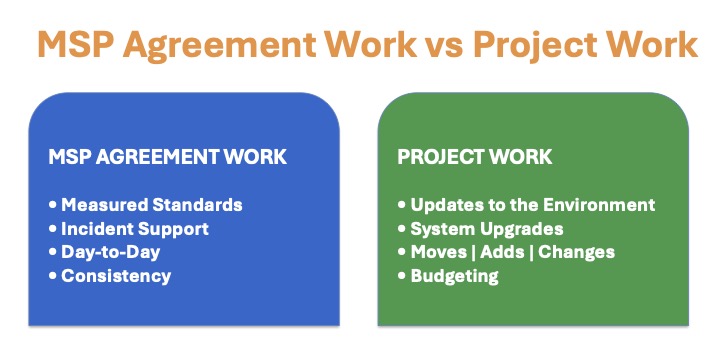
To answer this, let’s step back and look at the bigger picture: MSPs build their services around consistency & standards. These standards are the “box with defined edges,” guiding how systems are supported day after day. Projects, however, introduce a level of variability and risk that fall outside of that well-defined box. To protect your business—and ensure projects succeed—MSPs handle changes to the environment as unique engagements.

The MSP Goal: Consistency Over Chaos

Imagine two shapes:

  • A box with well-defined edges
  • A random blob with no boundaries

Supporting IT with standards is like working inside that well defined box. Everything has boundaries, processes are repeatable, and outcomes are predictable. Supporting IT without standards is like chasing a blob—it changes shape, has no clear rules, and slows everything down.

That’s why MSPs operate with well-defined practices:

  • Executing the same way, every day
  • Eliminating one-offs that create confusion
  • Simplifying support so that anyone on the service desk can assist
  • Accelerating time to resolution because environments look familiar across clients

For Morefield, achieving this goal means applying a set of standards to every environment we manage.

What Do MSP Standards Look Like?

Standards aren’t just abstract rules. They’re structured, written guidelines that touch on every area of technology critical to your business.

Here’s how Morefield organizes our standards:

  • By Category – We break technology down into strategic areas such as servers, workstations, security, networking, and cloud.
  • We Ask a Question – What exactly are we evaluating?
  • We Assign Priority – How critical is this to the environment?
  • We Define the Why – Why are we evaluating it? What risk does it address?
  • We Set a Frequency – How often should we check this? Monthly? Quarterly?
  • We Create a Process – What exact steps will we take to find the answer?

This isn’t guesswork. Standards are written with yes|no questions that provide clear edges to the “box.” For example:

  • Good: The system partition is at least 50GB.
  • Bad: What is the actual partition size?

By sticking to measurable parameters, MSPs keep environments predictable. Every system is checked, measured, and aligned to the standard. The result? A stable IT environment where support tickets are resolved quickly because surprises are minimized.

Why Projects Are Different

But here’s the catch: no IT environment stays frozen in time.

Changes, upgrades, and product replacements are inevitable. Hardware ages, software vendors retire applications, businesses expand into new locations, and users demand new capabilities. This is the normal life cycle of technology.

When it’s time to make changes, they can’t just be slotted into the “standards box.” A project is bigger than a support ticket. Projects introduce:

  • New variables that need planning
  • Budget implications beyond the monthly agreement
  • Dependencies across hardware, software, and employees
  • Measurable outcomes that must be tracked

If MSPs tried to include all of that within the flat monthly fee of a managed service agreement, one of two things would happen:

Costs would spiral, forcing higher costs for technology support.
Standards would erode, and projects would be rushed without proper planning.

Neither outcome benefits you the client. That’s why MSPs treat projects as separate events.

The Right Way to Manage IT Change

When Morefield undertakes a technology project, the objective isn’t just to “install the new thing.” It’s to manage the chaos of change so that your employees are happy with the outcome. Done correctly, projects:

  • Roll out smoothly with minimal disruption
  • Deliver measurable improvements
  • Stay on time and on budget
  • Leave the environment more standardized, not less

This is possible when projects are planned, budgeted, and executed as standalone efforts outside the monthly MSP agreement.

How Projects Are Identified and Planned

The good news is that project planning isn’t an afterthought. It’s built into the very fabric of the MSP relationship. At Morefield, we include strategic planning sessions as part of our agreements. These typically happen quarterly or bi-annually. During these sessions, we:

  • Review reports from monthly site visits and standards checks
  • Identify patterns and trends across your environment
  • Spot risks before they spiral into problems
  • Discuss technologies that could provide better business outcomes

Because the data is based on standards reviews that are conducted during monthly site visits, the conversation is grounded in facts, not guesswork. From there, Morefield will work with your organization to:

  • Apply budget to the issues identified
  • Rank priorities so the most important improvements come first
  • Create a roadmap for the next cycle of upgrades

This process ensures you’re not blindsided by surprise costs or rushed projects. Instead, each project is anticipated, budgeted, and aligned with your business goals.

Why the Separate Billing Matters

Think of it like remodeling your kitchen.

You wouldn’t expect your day-to-day handyman service to cover a full kitchen remodel. That renovation project requires a separate plan, a budget, specialized labor, and a timeline. You’d sit down with a kitchen contractor, agree on a scope, and understand the costs before any work begins. IT projects work the same way.

  • Moves, adds, and changes are like remodeling projects. They go beyond day-to-day maintenance and require specialized attention.
  • The monthly MSP agreement is like having a handyman on call—fixing things, maintaining systems, and ensuring consistency.

By keeping projects outside the monthly agreement, MSPs protect your budget, your systems, and your outcomes.

What to expect from a best in class MSP

The goal of your MSP is always the same: eliminate disruptions, standardize your environment, and deliver predictable outcomes. That’s why Morefield invests in building clear standards, monitoring them, and working with you to plan strategically.

But technology doesn’t stand still. When it’s time to make a change—whether migrating to new hardware, replacing a system, or adding new users—the rules shift. Those projects need to be handled separately to ensure they’re done right.

Yes, it means an additional investment. But just as with a home remodel, that investment is managed with a budget and a plan. The result isn’t just new technology—it’s an improved, more stable environment that supports your business for the long term.

Ready to Learn More About our Approach for Delivering Managed Services – Contact Morefield today

At Morefield, we believe that projects aren’t exceptions to your IT strategy—they’re part of the natural evolution of your business. By separating them from the day-to-day support agreement, we give them the attention they deserve.

And just like a trusted contractor helps you plan for your next home improvement project, we’ll help you plan, budget, and execute your iMAC projects so that your organization’s technology continues to enrich—not disrupt—your operations.

Choosing the Right Outside IT Support: Block of Hours vs. All-in Seat Price

frustrated employees over difficult IT situations

Considering Outside IT Support for Your Company

For many businesses, IT systems are both the backbone of operations and a recurring source of frustration. Organizations invest heavily in platforms, infrastructure, and upgrades—only to encounter unexpected disruptions, ballooning costs, and employees struggling with technology that doesn’t deliver on its promises. Even with help desk support, the reality often feels far from seamless.

This frustration leads many companies to consider a local partner for IT support. The idea is simple: bring in an external team to help stabilize systems, respond to issues, and keep technology aligned with business goals. But when businesses explore this option, they will encounter different models.  In this article we will explore two of those models.

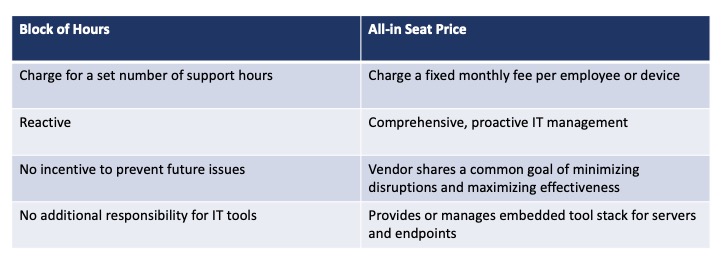
  • Block of Hours (BOH) Support Plans – You purchase a set number of support hours, and the provider steps in when an incident occurs and something breaks.
  • All-in Seat Price (AISP) Managed Services – You pay a fixed monthly fee per employee or device, covering a comprehensive, proactive approach to IT management.

Both models serve important purposes, but they deliver very different experiences, costs, and long-term value. In the paragraphs that follow we will cover both approaches, highlight lessons learned from real-world delivery, and help you decide which model fits your business best.

The Block of Hours Model

The Block of Hours (BOH) model is often the first option businesses consider when looking for outside IT help. At first glance, it feels practical and cost-efficient: you pay for a set number of hours and call in support when needed.

How It Works

  • You purchase a block of support hours from an IT vendor.
  • When a problem arises—server outage, software glitch, hardware failure—you call your vendor.
  • The vendor applies the necessary hours to resolve the immediate issue.

Why Businesses Choose BOH

  • Simplicity – Hours are easy to track, and the transactional nature feels straightforward.
  • Cost Control – Businesses believe they are only paying for what they use.
  • Flexibility – Smaller organizations may see it as a way to get IT support without committing to a full managed services agreement.

The Concealed Challenges of BOH

While attractive on the surface, this model has limitations:

  • Reactive Focus – The vendor’s only incentive is to fix what’s broken, not to uncover root causes or prevent future issues.
  • No Strategic Planning – There’s no framework for long-term improvement, planning, or technology alignment.
  • Tool Stack Responsibility – The business remains responsible for acquiring and managing critical IT tools: server administration software, endpoint management, backup systems, and cybersecurity solutions.
  • Misaligned Priorities – Business leaders may not know which issues to prioritize with limited hours. What feels urgent to them may not be what the IT environment needs most.
  • Disruption-Centered Relationship – The only time the vendor shows up is during a crisis. There’s no proactive evaluation, no planning sessions, and no roadmap for the future.

In essence, the BOH model is like paying for an emergency mechanic every time your car breaks down—without ever scheduling preventative maintenance or inspections.

IT Support Table

The All-in Seat Price (AISP) Model

The All-in Seat Price (AISP) model is a managed services approach where businesses pay a fixed monthly fee per employee (or device). Unlike BOH, this model is delivered under (4) quadrants of specialization, incident response, proactive management, embedded toolsets, and strategic planning.

How It Works

  • Businesses pay a predictable monthly fee based on the number of seats (users or devices).
  • Administrative tool stack is included under the program for endpoints + servers
  • Service delivery is divided into (3) key areas:
    • Incident Response – Help desk and problem resolution.
    • Proactive Activities – Monitoring, onsite visits, patching, endpoint management, and cybersecurity.
    • Strategic Planning – Long-term IT strategy tailored to business goals.

Why Businesses Choose AISP

  • Predictable Costs – A flat fee eliminates surprise invoices.
  • Proactive Care – Issues are prevented before they disrupt operations.
  • Embedded Tools – The vendor provides & manages the software stack necessary to keep IT systems and hardware healthy.
  • Greater Alignment & Shared Goals – Both vendor and client benefit from minimizing disruptions and maximizing technology effectiveness.

Benefits Beyond Break-Fix

With AISP, IT providers aren’t just problem-solvers—they’re strategic partners. This model fosters:

  • Continuous Improvement – Regular assessments, site visits and updates ensure systems evolve with the business.
  • Employee Productivity – Fewer disruptions so employees can focus on their work.
  • Data-Driven IT – Metrics such as ticket response times, backup success rates, patch compliance, and employee satisfaction scores provide visibility into IT performance.

Where BOH treats symptoms, AISP addresses causes and drives towards resilience.

Lessons Learned from Experience

When Morefield first began providing contracted IT support more than 15 years ago, our program was built on the Block of Hours model. We offered (4) tiers of support, each allocating a number of monthly hours to clients. Monthly statements detailed the services provided that included incident response, equipment deployment, and other needs. Sometimes hours weren’t consumed by end of month and would roll over into the next month.  But over time, patterns emerged:

  • Clients were stuck deciding between which issues deserved their limited hours.
  • Root causes of problems were rarely addressed, leading to repeat incidents.
  • Businesses lacked insight into IT performance and long-term strategic planning.

We realized that while hourly plans were affordable, the approach did not deliver real transformation for clients. So, we reimagined our delivery model, transitioning to an All-in Seat Price approach.

Yes, AISP plans are more expensive —but the outcomes are dramatically better. Instead of patching a problem, we help organizations make the smart technology decision to apply a permanent resolution. Instead of waiting for the panic call and disruption, our tiered services model prevents the disruption. The value lies not in the cost per hour, but in the productivity, resilience, and strategic advantage businesses gain.

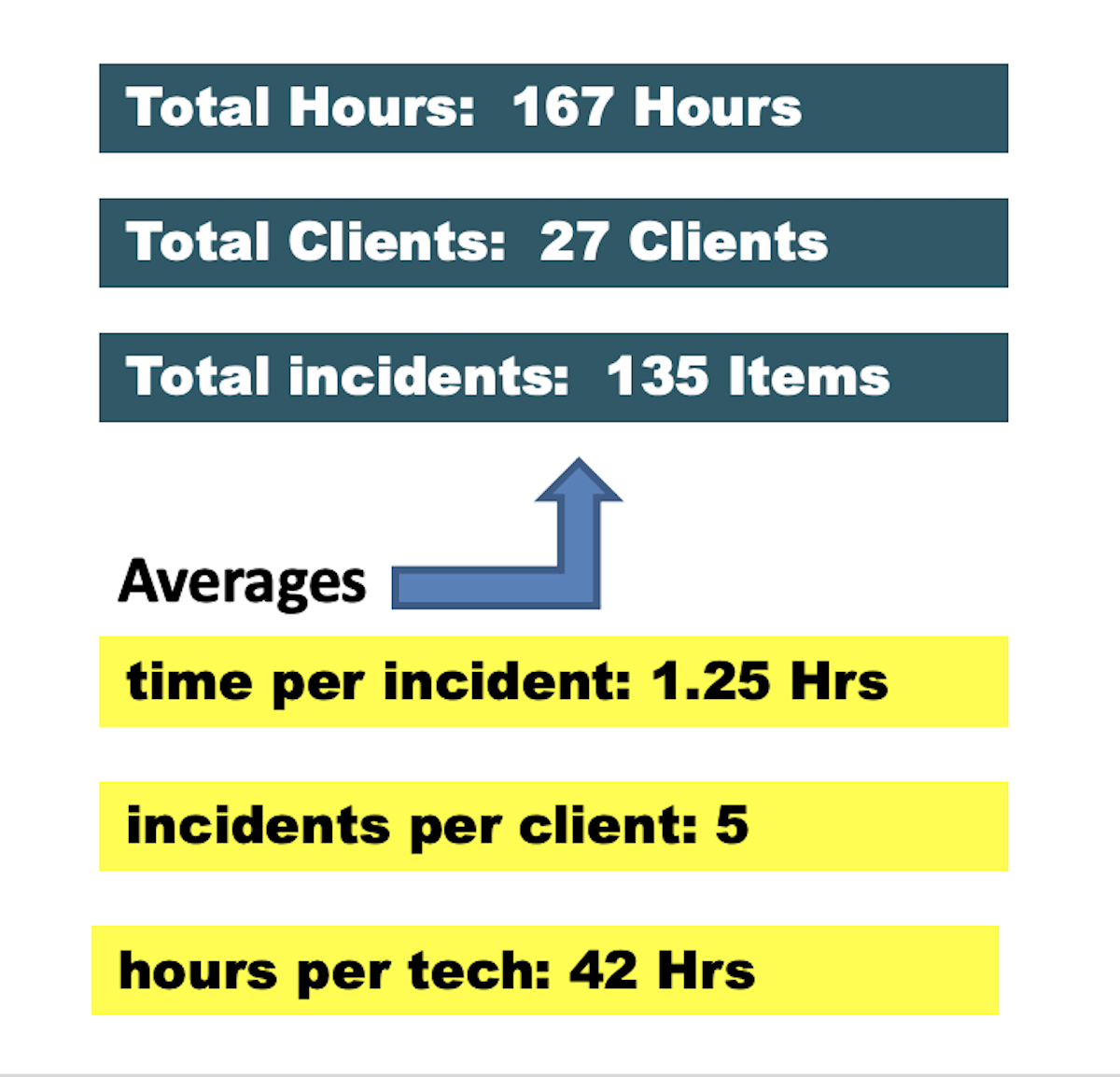
one month data

Measuring the True Value of IT

Before choosing a support model, businesses should ask themselves:

  • How many endpoints are being managed?
  • How many help desk tickets are created daily?
  • How reliable are backup routines?
  • How fast is response and resolution time?
  • Are devices patched and secured regularly?
  • What percentage of devices are vulnerable to ransomware?
  • How satisfied are employees with internal IT support?

If gathering this data feels difficult—or if you don’t know the answers—you may not have the visibility needed to evaluate your environment. In such cases, the proactive, data-driven nature of AISP becomes particularly valuable.

Morefield’s Perspective

At Morefield, we know there are businesses within Central Pennsylvania who would benefit from rethinking their approach to IT support. Many companies underestimate the true costs of IT—both visible expenses and hidden inefficiencies. They also struggle to recognize what “good” IT looks like.  When you invite Morefield to sit down and talk about your organization, our commitment to you, will be:

  • Redefine IT Support – Show your business how modern IT should be delivered.
  • Reveal True Costs – Help leaders understand both apparent and hidden technology expenses.
  • Empower Smarter Decisions – Equip organizations to make technology investments strategically, not reactively.
  • Deliver Lasting Value – Provide IT that not only works but enables growth, productivity, and security.

Which Program is Right for You?

Choosing between Block of Hours and All-in Seat Price isn’t just about cost—it’s about alignment with your business goals.

  • If your needs are minimal, predictable, and you only want support when something breaks, Block of Hours may feel sufficient.
  • But if you want to reduce disruption, empower employees, and align technology with strategy, the All-in Seat Price model delivers greater long-term value.

Your technology, that you rely on to operate your business, should not be a recurring frustration—it should be a driver of your businesses success. At Morefield, we help businesses make the smart technology decisions and move beyond reactive fixes and toward proactive, strategic IT support that works today and scales for tomorrow.

Planning a Migration to the Cloud: Should I Reuse my Handsets?

desk phone in an office

When organizations consider moving from a traditional on-premises telephone system to a Unified Communications as a Service (UCaaS), a common question that comes up in the planning is: Do we need to buy all new handsets?

When planning for a Cloud-delivered service, replacing hundreds—or even dozens—of desk phones represents a significant expense.  So many of the UCaaS suppliers will offer the option to repurpose your existing handsets to lessen out-of-pocket expenses.  And while it is possible to repurpose existing handsets for use with a UCaaS service, there are other factors to consider prior to a commitment.  This article explores how that process works, what’s required, and whether it’s the right decision for your organization.

From Proprietary Protocols to Open Standards

Traditional on-premises phone systems and handsets relied on manufacturer-specific operating systems and signaling protocols. These proprietary technologies—such as Cisco’s SCCP, Mitel’s MiNET, and Avaya’s UNIStim—were designed to integrate tightly with the manufacturer’s hardware and software ecosystem.

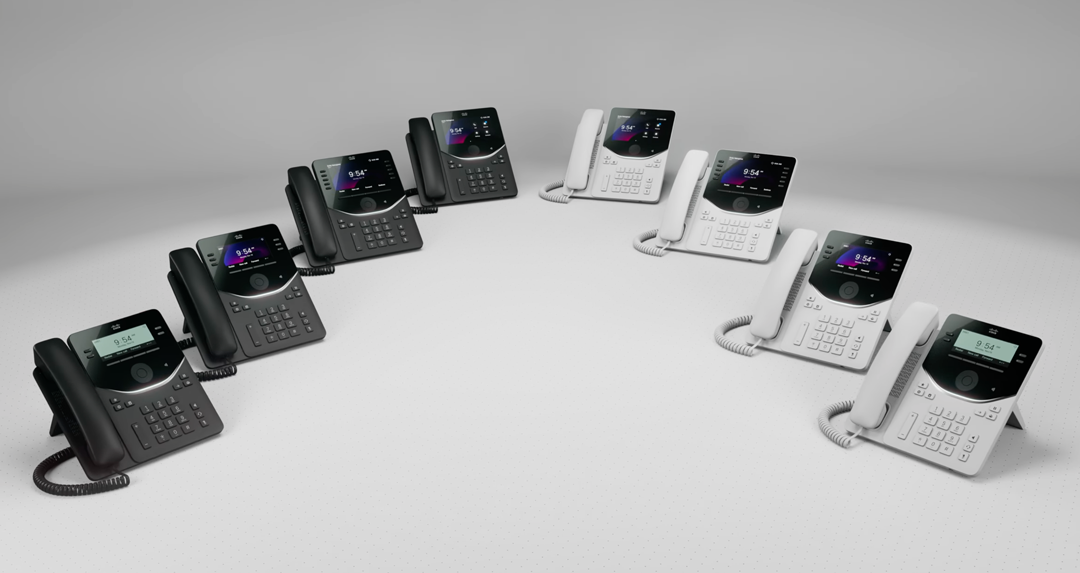
cisco 9800 lineup

How it Worked

In these systems, the phone acted as a client to the manufacturer server that hosted the voice application. When a user pressed a button, the phone sent a signal to the server, which dictated the phone’s actions in real time. This centralized command | control allowed manufacturers to deliver very rich enterprise features, simplified troubleshooting, and maintain a strong oversight of the entire system. The trade-off was that the handsets were effectively locked to that manufacturer’s environment.

The Promise of SIP

The introduction of Session Initiation Protocol (SIP) disrupted this proprietary approach. As an open, industry-standard protocol, SIP allows phones to be independent and intelligent. A SIP-enabled device can initiate, manage, and terminate calls directly, without relying on a central server for every function.

In other words, SIP handsets aren’t locked into a single vendor’s ecosystem—they can work with any platform that supports SIP, including most UCaaS providers. It is this interoperability that opens the door to reusing existing handset hardware instead of replacing it.

Why Older Handsets Can Work with UCaaS

If a handset can support a SIP image, it can often be migrated to a UCaaS platform. The process involves:

  • Re-flashing the firmware: Overwriting the handset’s proprietary operating system with SIP-compatible firmware.
  • Registering with the UCaaS platform: Once re-flashed, the phone can register with any provider that supports SIP.

This is not a provider-specific trick—SIP is an open standard, so the same approach applies across the UCaaS industry. However, not all handsets will qualify.

Checking Hardware Compatibility

Before you start planning a large-scale migration, you’ll need to confirm which handsets can make the transition. Key considerations include:

  • Hardware capacity: Older circuit boards may lack the processing power or memory to run new SIP firmware effectively.
  • Security certificates: Many older proprietary phones do not have the embedded certificates required for secure UCaaS connections.
  • Manufacturer and model support: UCaaS providers typically publish compatibility tables that list approved handset models and firmware revisions. You can find the handset’s revision number on the product label (often on the back of the phone) or through the device’s administration menu.

If a handset doesn’t appear on the compatibility list—or if it lacks the required hardware—it’s usually best to replace it rather than attempt an unsupported upgrade.

The Re-Imaging Process

Once you’ve confirmed that your phones are compatible, you can begin the re-imaging process. The goal is to have a repeatable, documented procedure that minimizes disruption.

Steps to follow:

  1. Document the workflow
    Break the process down into clear steps, noting the average time per handset—usually around 15–20 minutes.
  2. Leverage automation
    Use protocols such as TFTP, HTTP, or HTTPS to push firmware updates to multiple devices. Most phones will reboot automatically once the upgrade is complete.
  3. Assign responsibilities
    Decide whether the process will be handled by IT staff, end users, or a combination of both.
  4. Schedule a maintenance window
    Once re-flashed, the phone may no longer function on the old system. To avoid disruptions, perform upgrades during off-hours or low-traffic periods.
  5. Have a fallback plan
    Keep a stock of old-system-compatible handsets in case something goes wrong during migration.

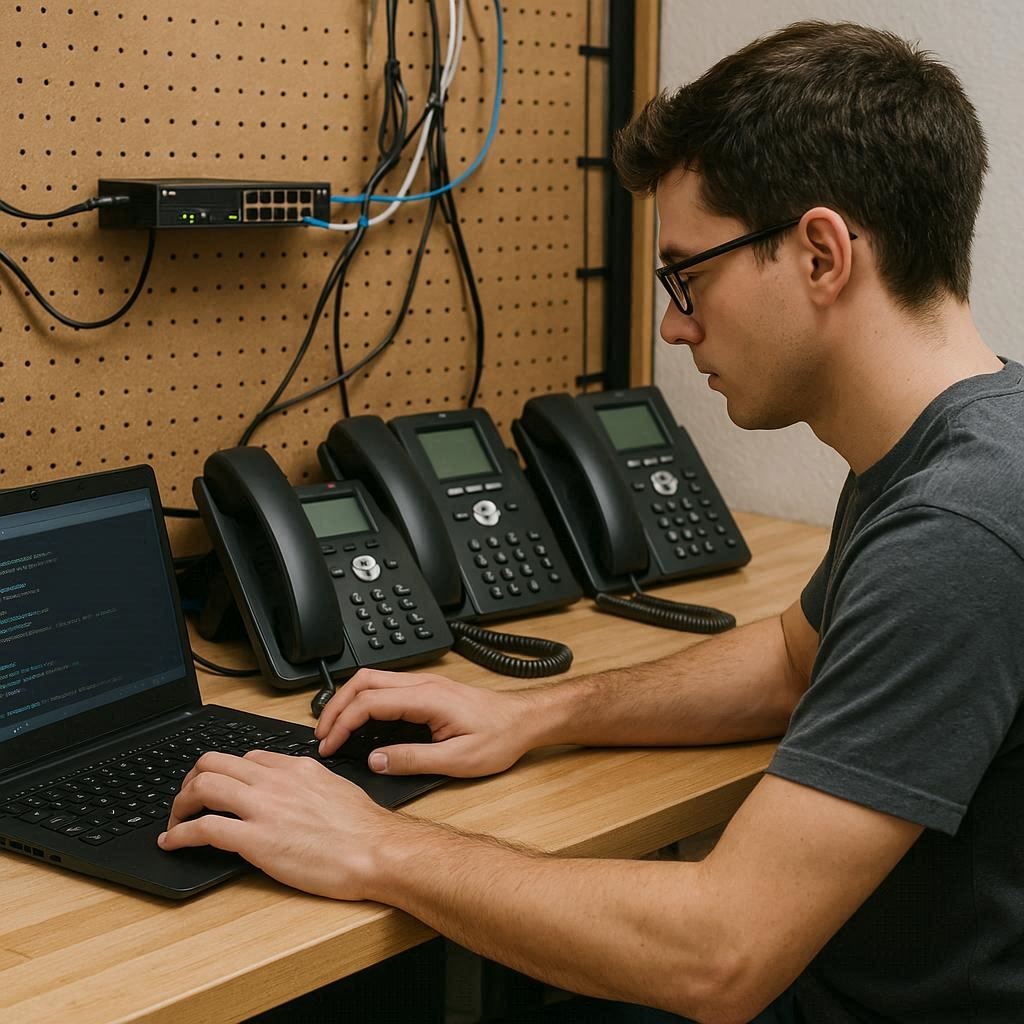
tech working on deskphone

Is It Worth It?

Before committing to re-deploying older handsets, consider both the operational and financial implications.

User adoption patterns:
Most UCaaS migrations do not involve replacing every desk phone one-for-one. Many employees opt for softphones or mobile apps instead of physical handsets. Identifying who still needs a desk phone is an essential first step.

Inventory exercise:
Count how many compatible handsets you have and compare that to the number of users who prefer a physical phone.

Cost savings:
High-end proprietary handsets were once as expensive as desktop PCs. Today, competitive SIP-standard models from manufacturers such as Poly and Yealink often cost less than $200. Some UCaaS providers even rent them for $3–$5 per month. Calculate whether the savings from reusing older phones justifies the effort of re-imaging them.

The Benefits of Standardization

In the era of proprietary systems, standardizing on a single handset model across the organization simplified training, reduced downtime, and lowered repair costs. The same principle holds true with UCaaS—choosing one or two SIP-standard models for the entire company streamlines operations and support.

Even if you plan to reuse older phones during the migration, it may be wise to phase in a standardized SIP model over time. This hybrid approach can give you immediate cost savings while aligning with long-term operational best practices.

What Morefield is Sharing With Our Clients

Migrating existing handsets to a UCaaS platform is a viable option for many organizations, but it’s not without caveats. You’ll need to:

  • Verify hardware compatibility
  • Establish a structured, repeatable re-imaging process
  • Account for user preferences and adoption patterns
  • Weigh the savings against the cost of new hardware

For companies with a large inventory of compatible handsets and a user base that still values desk phones, re-imaging can provide a cost-effective bridge into the UCaaS world. For others, the reduction in new handset prices and the flexibility of cloud-based communication may make purchasing new SIP-compatible devices the more straightforward option.

Either way, the key is to plan carefully. A well-executed handset migration—or replacement—will ensure your UCaaS transition is smooth, efficient, and cost-effective.

Starlink vs. Cellular Internet: Which Wireless Service Fits Your Business Best?

As organizations become increasingly dependent on reliable, high-speed internet to run daily operations, the importance of having the right connectivity solution can’t be overstated. Businesses are looking beyond traditional cable and fiber connections to wireless options like Starlink satellite internet and cellular internet (4G | 5G) — whether as a primary service in remote areas or as a backup to their terrestrial network.

This article breaks down the strengths, limitations, and use cases for both Starlink and cellular internet, exploring the different roles in how each can be used for servicing your network, and offers guidance on which might be the best fit for your organization.

About Starlink

Coverage and Availability
Starlink, SpaceX’s satellite-based internet service, is available anywhere with a clear line of sight to the southern sky. This expansive coverage makes it a compelling choice for rural and underserved organizations in central Pennsylvania where terrestrial and cellular options are limited.

Performance
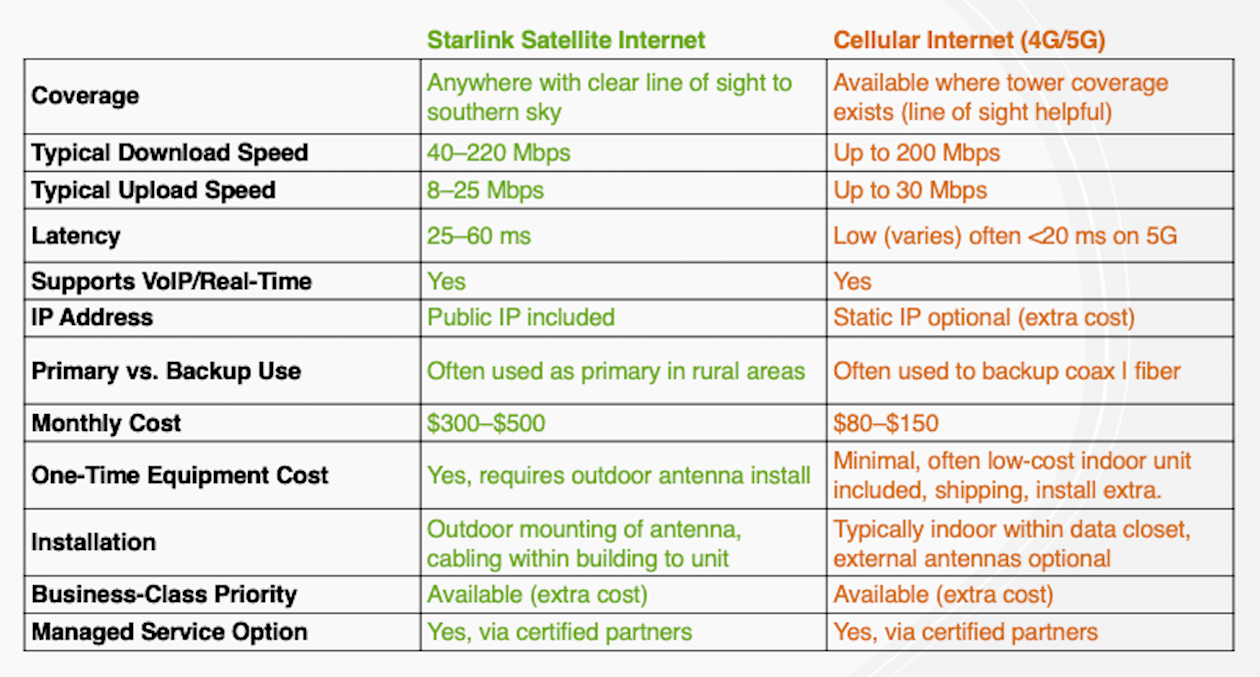
Starlink offers asynchronous data speeds ranging from 40–220 Mbps download and 8–25 Mbps upload, along with a public IP address. Latency typically falls between 25–60 milliseconds, which is low enough to support VoIP and other real-time applications without noticeable lag.

Data Plans and Service Options
Starlink’s flexible data plans can be tailored for different scenarios, whether as a primary internet connection or as a backup link. In practice, Starlink is more often deployed as a primary connection in areas without other viable options.
For business needs, the Business Class Priority Plan is worth serious consideration. With this plan, your connection gets priority on the network, ensuring more consistent speeds even during high-demand periods.

Budgeting for Starlink
Expect monthly costs for Starlink business service ranging from $300–$500, though the exact price depends on:

  • Data requirements for your use case
  • Whether the service is primary or backup
  • Choice of priority plan for higher throughput
  • Additional recurring fees if offered as a managed service by an authorized partner.
    And, there’s a one-time equipment and installation cost, which can be significant due to the outdoor installation requirements of the antenna.

About Cellular (4G | 5G) Internet

Coverage and Availability
Cellular internet uses 4G | 5G networks to deliver connectivity, with performance dependent on proximity and line of sight to the nearest tower. When conditions are optimal, cellular service can deliver impressive speeds.

Performance
With strong tower coverage and line of sight, cellular internet can achieve 200 Mbps download and 30 Mbps upload speeds. While latency is already low on 4G and even lower on 5G, performance will still vary depending on network congestion and environmental factors. Static IP addresses are available from many carriers for an additional charge.

Data Plans and Service Options
Cellular internet supports VoIP and other real-time traffic with minimal latency and packet loss. Carriers may offer:

Tiered or pooled data plans for managing costs, as well as unlimited data plans

Business-class service levels

Pricing typically falls between $80–$150 per month, though, as with Starlink, final costs will depend on:

  • Data plan size
  • Priority service selection
  • Equipment purchases or leases
  • Optional managed services from certified partners

In most deployments, cellular is used as a secondary backup connection to a wired (fiber | coax) service. However, some organizations with optimal conditions have successfully run the service as their primary connection.

image of cellular tower

Wireless as a Failover: Key Considerations

Both Starlink and cellular can function as part of a failover strategy to keep your network running during primary service outages. Here are some important points to keep in mind:

  1. Compare Carrier Pricing
    Shop multiple carriers and request quotes for plans that match your anticipated data usage. Many will include equipment with an activated SIM card for cellular service.
  2. Network Edge Appliance Behavior
    If you’re using a cloud-managed network edge appliance such as Cisco Meraki or Fortinet, it will maintain “keep alive” messages across both primary and secondary connections. These pings consume small amounts of bandwidth, which could matter on a limited data plan — even when the wireless connection is idle.
  3. Overage Costs vs. Downtime Costs
    When on a limited data plan, failover events will result in overage charges. However, the cost of exceeding your plan is often far less than the cost of business downtime.
  4. Post-Failover Behavior
    When your network fails back to the primary connection after an outage, existing sessions on the wireless link remain active on that link until they end naturally. This gradual failback can lead to unexpectedly high wireless data usage after the primary service is restored.
    A simple workaround: temporarily disable the wireless connection post-failover to force all traffic back to the primary.

Which Service Is Right for your Organization?

Choosing between Starlink and cellular comes down to coverage, performance requirements, and how you plan to deploy the connection.

When Cellular Makes More Sense

  • Best Value in Coverage Areas: If your location has strong 4G | 5G coverage, cellular offers fast speeds for the price, with basic plans that offer value under Starlink’s cost.
  • Indoor Equipment Setup: Cellular equipment typically resides in your network closet and requires no rooftop work, making installation simpler.
  • Flexibility: External antennas can be deployed for better reception in challenging signal environments, though these cases often require engineering help from an authorized partner.

When Starlink Is the Better Option

  • Broad Coverage in Rural Central Pennsylvania: In regions where cellular service is weak or non-existent, Starlink is often the only high-speed option available.
  • Business-Class Priority Needs: Organizations that need consistent speeds during peak hours benefit from Starlink’s priority service tier.
  • Willingness for Outdoor Installation: Starlink requires a mounted antenna with clear line of sight to the southern sky, plus cabling into the building — something to budget and plan for.

service comparison table

Installation and Support

Both services can be installed by authorized, certified partners, which is strongly recommended if your team lacks experience with the technology. Partner installation ensures correct setup, optimal performance, and support for ongoing troubleshooting.
When purchased as a managed service, the provider takes care of monitoring, maintenance, and upgrades — freeing your IT team to focus on other priorities.

Ready to Pick the Best Service for your Organization – Contact Morefield

In a perfect world, every business would have fast, affordable, and reliable fiber optic Internet service. In reality, many locations — especially across central Pennsylvania — require a different approach. Starlink and cellular internet are both viable solutions, each with unique strengths:

  • Cellular is often more cost-effective where coverage exists and can be quickly deployed indoors with minimal disruption.
  • Starlink provides unmatched reach in rural locations and can offer business-class priority for consistent speeds.

For most organizations, the decision isn’t “either/or” — it’s about how each technology fits into your layered connectivity strategy.  Applying these services as a primary connection or as a failover can provide maximum uptime, ensuring your business remains connected even during unexpected outages.

Sign Up for Our Newsletter