What is the NIST Cyber Security Frameworks (CFS) & How Will It Help My Company?
October 10, 2022 |
[3 min. read]
by Allan Jacks, vCISO
When I started my career in the military, I wanted to do all the cool stuff I heard about from my recruiter. But then week one started into my 6-month initial training course. I was given what seemed like a mountain of books to use and reference. Many of them were published by the Combined Communications Electronics Board which prescribed standards to be used when conducting communications within member nations. For successful communication, you must speak the same language and when it came to electronic communications, it had a standard and protocol that all who were involved adhered to.
This allowed successful communications between multiple parties to occur in an orderly manner.
As an engineer, we like to have order in our world, and by following templates, rules, guidelines, and best practices, we understand what to expect when implemented correctly.
A framework is exactly that!
What is a Cyber Security Framework?
From the NIST glossary, a Framework is defined as:
“A set of cybersecurity activities and references that are common across critical infrastructure sectors and are organized around particular outcomes. The Framework Core comprises four types of elements: Functions, Categories, Subcategories, and Informative References.”
NIST developed the Cybersecurity Framework in 2014 to provide voluntary guidance for critical infrastructure organizations.
Even though this framework may have been focused on critical infrastructure organizations initially, the NIST CSF is an excellent framework to follow and protect your company’s critical infrastructure. “The framework was developed with a focus on industries vital to national and economic security, including energy, banking, communications, and the defense industrial base. It has since proven flexible enough to be adopted voluntarily by large and small companies and organizations across all industry sectors, as well as by federal, state, and local governments.”
What Does the NIST CSF do?
Every company that relies on its network and the importance of its reliability should consider its network vital to economic security. The NIST Cybersecurity Framework is a proven framework to protect their business.
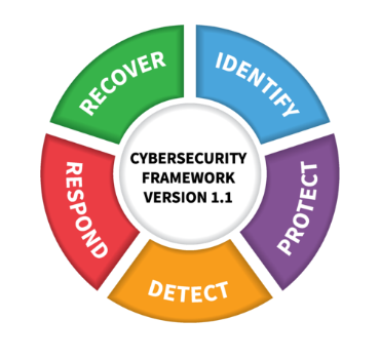
NIST CSF is made up of 5 core functions: Identify, Protect, Detect, Respond and Recover. These functions provide an overview of the cyclical process for managing cybersecurity risk.
Identify
First identify what your business’s core function is, what is the mission, and why it exists. What are the core assets that make up the business that needs to be secured? These can include physical assets and people. To continue the business, what third parties do I need to continue business successfully?
Protect
Second is the protection of the components identified to ensure the availability of infrastructure services. By protection, we limit the impact of a cybersecurity event through the implementation of policies and procedures, managing the maintenance of infrastructure, and establishing data protection to protect the confidentiality, integrity, and availability of the company’s information.
Detect
The third is to allow continuous monitoring of logs that can identify any anomalies occurring within the infrastructure that may point to a cybersecurity event.
Respond
Fourth is to detail the actions to be taken in the event a cybersecurity incident occurs. Being prepared to act and knowing what action to take before it occurs will allow an ordered process to limit the damage caused. By practicing what to do, the stakeholders will be better prepared in the event of an incident.
Recover
Finally, in the event of an incident implementing planning processes to restore assets to working order, will allow quicker return to service and return to business operations. Evaluating what went wrong, what went right, and what can be improved, will allow the optimization of the processes, and reduce cybersecurity risk to the organization.
NIST Resources
Just like the Allied communications books that I read in the military, the NIST publications can be quite challenging to read. One does not just pick them up and follow from chapter one through the ending to fully secure your company’s system, though they do have a quick start guide which can be found here:
With the changing cybersecurity technologies and threats, NIST is currently working on updating the NIST Cybersecurity Framework to version 2.0. Information can be found here:
No company is too small to follow parts of the NIST CSF and by doing so, your company will be better prepared in the event of a cybersecurity incident.
Trust Morefield with NIST CSF
At Morefield, we can assist in providing guidance or assist you in implementing the NIST CSF Framework within your organization. Our team of experts is ready to start talking to you about your needs and goals. Contact our team now!
PENNSYLVANIA (WHTM) – Some Pennsylvania residents will see a new area code come into effect starting next month.
The Pennsylvania Public Utility Commission says residents and businesses in eastern and southeastern Pennsylvania should be aware of the upcoming September 2 activation of a new 835 area code…….
Let Morefield help, email or call with any questions- 717-761-6170 or sales@morefield.com
All About Penetration Testing for Businesses
August 26, 2022 |
As internet use grows, cybersecurity becomes ever more vital to business success. With the global average data breach cost of $4.24 million, businesses need reliable cybersecurity technology and services to protect their data.
An effective tool in a business’ cybersecurity strategy is penetration testing. The penetration testing process is the most effective way for an organization to gain a complete picture of their security posture. Understanding penetration testing and how it can benefit your business or organization can help you decide whether it is a good fit for you.
What Is Penetration Testing?
Penetration testing, also called pen testing or security pen testing, is a simulated cyberattack against an organization’s security policies. The penetration team performs the attempted attack using various tools and strategies to gain access to systems and information. The primary goal is to find a system’s vulnerabilities before cybercriminals do and strengthen them against a potential attack.
Penetration testers work with an organization to test security solutions currently in place. Through penetration testing, organizations can attempt to exploit potential weak spots in the following systems:
Networks
Websites
Servers
Computer systems
Applications
The penetration testing process identifies issues and helps businesses implement more effective cybersecurity controls. Penetration testing can also help an organization solve problems with its:
Compliance
Employees’ security consciousness
Cyberattack response protocol
Common Penetration Testing Methods
Penetration testing involves different hacking techniques to evaluate multiple security measures. These strategies may include the following.
Internal testing: Internal tests simulate attacks from a malicious insider within the organization. These tests attempt to determine what information an authorized user could access from within the network or what could happen if an attacker successfully infiltrated the system.
External testing: A simulated attack on an organization’s network perimeter is an external test. To extract sensitive data, these tests target an organization’s assets, like its website, email, and domain name servers.
Targeted testing: Target tests involve the organization’s security staff by having the testing team walk them through each step of the test. This exercise helps security understand how a hacker might think.
Blind testing: Some hackers attempt to penetrate a system with little or no information about the organization. A blind test simulates this scenario as the testing team attempts to hack into the system using only publicly available information to conduct penetration tests.
Double-blind testing: A double-blind test keeps the organization’s IT staff ignorant of the penetration test. This exercise evaluates the security policies and the IT staff’s monitoring and response capabilities.
Do Small Businesses Need Penetration Testing?
Penetration testing is a form of ethical hacking that exposes an organization’s vulnerabilities so it can improve its security measures. This procedure can benefit organizations that believe their data is secure but may have weak spots they want to address.
Some small businesses might not see the importance of penetration testing, thinking cyberattacks aren’t as much of an issue for them. Small businesses might also believe their data isn’t worth stealing. However, cybercriminals may find small businesses attractive targets because they lack the security infrastructure of larger corporations and organizations. Even small companies have information cybercriminals could use, including:
Employee records
Credit card numbers
Bank account information
Third-party access to larger networks
Small business penetration testing helps companies protect this information and proactively develop strategies for defending their systems against attack. With pen testing for small businesses, companies can learn how to manage their susceptibility to attack and gain valuable insight into the most effective information security risk management strategies.
The Penetration Testing Process
Penetration testing is a thorough, carefully researched process with several stages.
1. Planning
Preparation for the penetration testing process is essential. The organization and testing team must agree on the test’s goals and scope. In this stage, the organization decides the test’s timing, which methods to use, who should know about the test, and how much information the testers will have.
2. Discovery
In this stage, the testers conduct reconnaissance and gather as much information as possible about the targeted network, systems, users, and applications. Collecting information helps the test team understand how their target works and identify its potential vulnerabilities. The test team might gather information such as:
The organization’s network and domain names
IP addresses
CEO, CFO and other staff names
Staff email addresses
Infrastructure and applications used
3. Penetration Attempt
During the penetration attempt, testers seek to bypass the organization’s security controls and gain access to systems and applications run by the organization. The testing team analyzes the organization’s weak spots through scanning and other tools. The team exploits any known vulnerabilities, including the organization’s staff. Depending on their goals, the team may see how far they can infiltrate the system and how much data they can obtain.
4. Analysis and Reporting
After the testing team is complete, the testers prepare a detailed report communicating the access they were able to achieve and the vulnerabilities they exploited to gain this access. The results of penetration tests are valuable security planning tools because they describe the vulnerabilities that an attacker might exploit to gain access to a network. The report also includes advice on improving the organization’s security posture.
5. Cleanup
At the conclusion of the penetration test, pen testers should be careful not to leave a trace of their presence in the organization’s network. Testers should remove any tools that they installed on systems as well as any persistence mechanisms that they put in place. Attackers could leverage any evidence the testing team leaves behind.
6. Retest
Penetration testing is most effective when completed over time. The organization can use the testing report to implement security solutions in preparation for potential attacks. However, hackers and technology are constantly changing. With multiple tests, organizations can continually improve their processes.
Penetration Testing FAQs
Businesses and organizations that have never performed penetration testing might have questions about the process. Here are answers to some common penetration testing questions.
1. Can Penetration Testing Be Remote?
Penetration testing can be on-site or remote, depending on the testing team’s capabilities. Remote penetration testing provides several advantages.
High tester availability: Technological advances allow remote penetration testing teams to offer effective, timely, and responsive services.
Greater flexibility: Remote penetration testing only requires remote access, making this test ideal for organizations looking for higher speed.
2. How Often Should You Pen Test?
Businesses should have regular penetration testing to ensure their networks and systems are effective against emerging cyber threats. It can also be beneficial to have penetration testing done whenever security changes significantly, such as when the organization:
Modifies user policies
Adds applications or infrastructure to the network
Applies security patches to the system
Establishes new locations
Finishes upgrading applications
3. How Much Does Penetration Testing Cost?
Penetration tests are comprehensive evaluations of an organization’s network security that provide detailed recommendations for enhancing protections. As with other cybersecurity services, the cost of penetration testing varies depending on several factors:
The testing method used
The complexity of the organization’s network and systems
The tester’s experience
Whether the penetration test is remote or on-site
4. What are the Benefits of Penetration Testing?
You learn whether an attacker can penetrate your defenses
You gain a detailed blueprint for remediation
You gain focused information on specific attack areas
Do You Need Penetration Testing Done?
Penetration testing is a valuable strategy for improving your organization’s ability to resist cyberattacks. The process arms organizations with insight into their systems and the tools they need to improve them.
When you need penetration testing for your organization, turn to Morefield. We offer a range of business security and IT services to help businesses and organizations understand their security needs. With over 70 years of experience in the industry, we provide unmatched customer care and expertise.