

What to Watch for After You Understand the Basics
By the time most senior living leaders finish learning how a life safety system works, they feel confident. They understand pendants. They understand repeaters. They’ve reviewed coverage plans and installation timelines.
And yet, many of the real problems don’t appear during installation week.
They appear months later—after residents move in, after staff changes, or after the first serious incident tests the system under real conditions.
This article isn’t about how the technology works. It’s about the quiet failure points that experienced operators learn to watch for in wireless, RF-based life safety systems.
Where Good Installations Start to Drift
Most “bad installs” aren’t the result of negligence. They’re the result of reasonable decisions made under pressure.
A repeater gets installed where it’s easiest to access instead of where signal margin is strongest. Fingerprinting gets rushed to meet a move-in date or deadline. Documentation gets skipped because “we’ll remember where everything is.”
Each decision feels small at the time. Together, they create risk.
The False Sense of Coverage
One of the most common assumptions after go-live is: “We tested the pendants—everything works.”
The challenge is that RF environments change.
Empty resident rooms and apartments behave differently once residents move in. Furniture, beds, medical equipment, and even wall décor can absorb or reflect signals. Human bodies themselves affect RF behavior.
If the system wasn’t designed with enough signal margin from the start, coverage can slowly erode—without obvious warning signs.
Strong installations don’t just work on day one. They’re designed to tolerate change.
When Supervision Gets Tuned Down
Life safety systems are intentionally vocal. Devices check in. Batteries report status. Infrastructure confirms it’s online.
Problems arise when supervision is treated as “noise” instead of early warning.
When alerts are ignored—or supervision intervals are relaxed—devices can fail quietly. A repeater loses power. A pendant battery weakens. A gap forms without anyone noticing.
Supervision isn’t an inconvenience. It’s how the system tells you something needs attention before there’s an emergency.
Supervision isn’t an inconvenience. It’s how the system tells you something needs attention before there’s an emergency.
Power Is Unexciting—Until It Fails
Power design rarely gets much attention during installation.
Transformers are plugged in temporarily. Outlets aren’t labeled. GFCI circuits seem like a safe choice. Months later, someone unplugs a device during cleaning or a breaker trips. Coverage disappears silently.
The most reliable senior living systems treat power as permanent infrastructure, not temporary convenience.
Documentation Protects You From Turnover
Senior living communities change. Staff changes. Administrators change. Vendors change.
Repeaters installed above ceiling tiles are intentionally out of sight. Without clear documentation, institutional knowledge disappears. What once made sense becomes guesswork.
Good documentation isn’t about today’s team. It’s about protecting the community years down the road.
Fingerprinting Is Easy to Rush—and time consuming to Redo
Fingerprinting is often the most time-pressured step in an installation.
When it’s rushed, location accuracy suffers. Alerts still come through—but staff may second-guess where to respond. That hesitation matters.
Redoing fingerprinting after a system is operational is far more disruptive than doing it right the first time.
Wrapping up – And What to Do Next
When life safety systems underperform, it’s rarely because the technology wasn’t capable. It’s because small process decisions—made under pressure—compound over time.
A rushed system installation
An undocumented repeater or supporting hardware.
Supervision alerts that get ignored.
A power source that wasn’t secured properly.
Individually, they seem minor. Collectively, they create risk.
The Senior Living Communities that experience the fewest issues treat their life safety system as critical infrastructure. They document it. They test it. They revisit it. And when questions arise, they don’t guess—they validate.
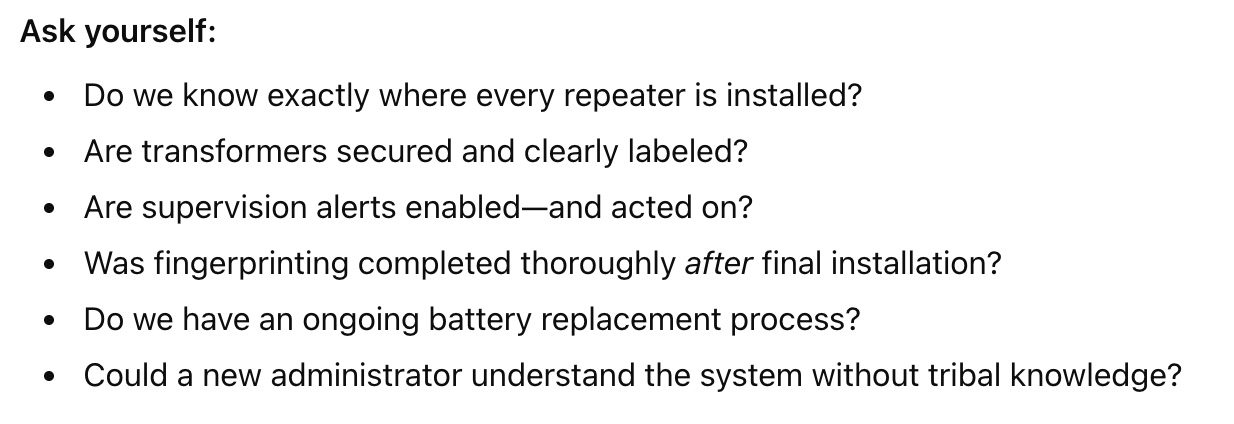
If you reviewed the self-assessment above and found yourself hesitating on a few answers, that’s not a failure. It’s an opportunity. An independent system evaluation can quickly identify:
- Coverage gaps
- Supervision configuration issues
- Power or infrastructure vulnerabilities
- Documentation deficiencies
- Fingerprinting inconsistencies
And in many cases, the fixes are straightforward when addressed early.
If you have concerns about your current life safety system—whether it was installed recently or years ago—Morefield’s team can perform a structured evaluation and provide clear, actionable recommendations.
Because in senior living, confidence isn’t optional.
It’s built on knowing your system will work when someone truly needs it.
If you’d like a professional review of your environment, contact our team to schedule a life safety system evaluation. We’re here to help you make smart technology decisions that protect your residents, your staff, and your community.