

Over the past year, there’s been no shortage of headlines offering advice on how organizations should prepare for AI-driven transformation. Analysts, vendors, and consultants alike are publishing frameworks, maturity models, and predictions for what 2026 will bring.
In a previous discussion on agentic AI, we explored how IT’s role evolves as systems become more autonomous. Then following up within this article we will discuss those projects and how that responsibility becomes real. Despite the variety of perspectives, most of these stories converge around a familiar set of themes:
- Infrastructure
- Responsibility
- Trust
- Humans in the loop
- Company data as the engine for AI
These are all critical considerations. Some, like trust and responsibility, demand deep governance, cultural change, and executive alignment. They take time, careful planning, and cross-functional ownership.
Others, however, are far more approachable—and far more actionable—right now. From Morefield’s perspective as a managed service provider in Central Pennsylvania and technology advisor across multiple industries, 2026 readiness starts with (2) foundational project areas that organizations can—and should—prioritize today:
- Infrastructure
- Data
When you get this right, your organization will have the conditions for responsible, trustworthy, and scalable AI adoption. Ignore them, and even the most advanced AI initiatives will stall under their own weight.
Why AI Readiness Is an Infrastructure Conversation First
AI and automation are not “plug-and-play” workloads. They place very different demands on IT environments compared to traditional line of business applications.
As organizations look ahead in 2026, AI-driven systems will increasingly operate as distributed, always-on, multi-agent environments—not as single applications running in isolation.
That reality has major implications for infrastructure planning.
Advanced Networking Is No Longer Optional
AI agents need to communicate—constantly. They exchange signals, context, and results across systems in real time. That means networks must evolve well beyond basic connectivity.
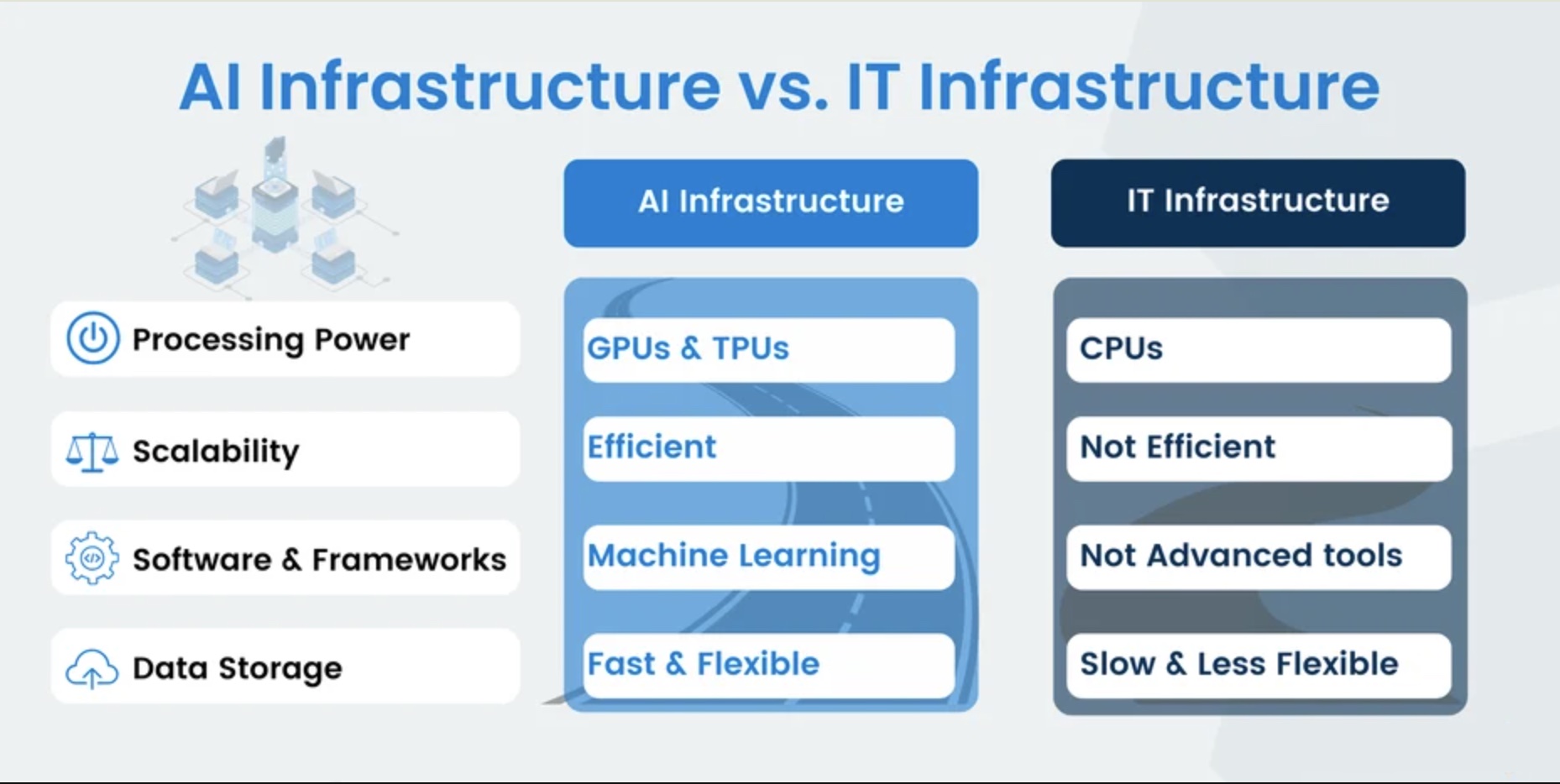
Organizations should be planning for
- Ultra-low latency networking to support real-time decision-making
- High-throughput architectures capable of moving large data sets efficiently
- Energy-efficient designs that control operating costs as workloads scale
- Security embedded at every layer, not bolted on afterward
In practical terms, this often means refreshing core switching, modernizing WAN architectures, adopting software-defined networking, and rethinking how edge locations connect back to centralized resources.
For many SMB | Midmarket organizations, this is less about bleeding-edge technology and more about eliminating bottlenecks from legacy systems. Systems that AI will quickly expose.
Flexible, Scalable Compute Is the New Baseline
AI workloads are bursty by nature. Demand spikes. Models retrain. Agents scale up and down dynamically. Rigid, fixed-capacity infrastructure struggles in this environment.
As your team plans, compute strategies should prioritize:
- Hybrid architectures that blend on-prem, cloud, and edge resources
- Elastic scalability to align cost with actual usage
- Workload portability, avoiding lock-in that limit future options
This is where many organizations discover that yesterday’s “cloud-first” strategy isn’t enough. AI introduces workloads that may need to live close to users, machines, or data sources—while still integrating with cloud-based intelligence.
Multi-Nodal Architectures Reflect How AI Actually Works
One of the most overlooked infrastructure shifts is the move toward multi-nodal architectures. In an AI-enabled domain, some agents will operate in the cloud. Others run at the edge—inside facilities, warehouses, or branch offices. And then humans monitor, intervene, and guide outcomes in real time.
This requires environments where workloads can operate in concert, not silos. Networking, identity, monitoring, and security must be consistent across every node.
Organizations that plan for this now will move faster later—without re-architecting under pressure.
Your Company Data Is the Real AI Differentiator
If infrastructure is the foundation, your company data is the fuel.
Agentic AI systems rely heavily on human-generated company data—documents, communications, operational records, transactions, and institutional knowledge. Unlike public internet data, this supply is finite and deeply contextual.
That reality introduces both opportunity and risk.
Identify and Prioritize High-Value Data Sources
Not all data is equally valuable to AI systems. A critical planning exercise is identifying:
- Which data sets will drive the most meaningful AI outcomes
- Where that data currently lives
- How frequently it changes
- Who owns and governs it
This often reveals data sprawl, duplication, and inconsistent access controls—issues that must be addressed before AI agents are allowed to act on that information.
Manage Overlapping Data with Intentional Silos
AI does not eliminate the need for separation of duties. In fact, it reinforces it.
Where overlapping data sets exist, organizations will need to intentionally silo data to maintain operational boundaries between AI agents. This helps reduce unintended cross-influence between processes. Improves explainability of outcomes and supports compliance and audit requirements.
Silos are not about isolation—they’re about control and clarity.
Plan for the Explosion of Synthetic Data
AI agents don’t just consume data. They will generate it. Likely a lot of it.
Automated processes, simulations, predictions, and derived insights all create synthetic data that must be stored, secured, and governed.
Organizations preparing for production AI should be asking:
- Where will synthetic data live?
- How long is it retained?
- How is it distinguished from human-generated data?
- How is it used to retrain or influence future models?
Ignoring this creates risk. Planning for it creates leverage.
Adopt Platforms Designed for Both Human and Synthetic Data
Traditional data platforms weren’t designed for AI-scale complexity. Forward-looking organizations are evaluating platforms optimized to handle large volumes of unstructured data. Support AI-native analytics and workflows and still enforce security and governance consistently.
This is not a rip-and-replace conversation for most SMB | Midmarket organizations. It’s about evolution with intention.
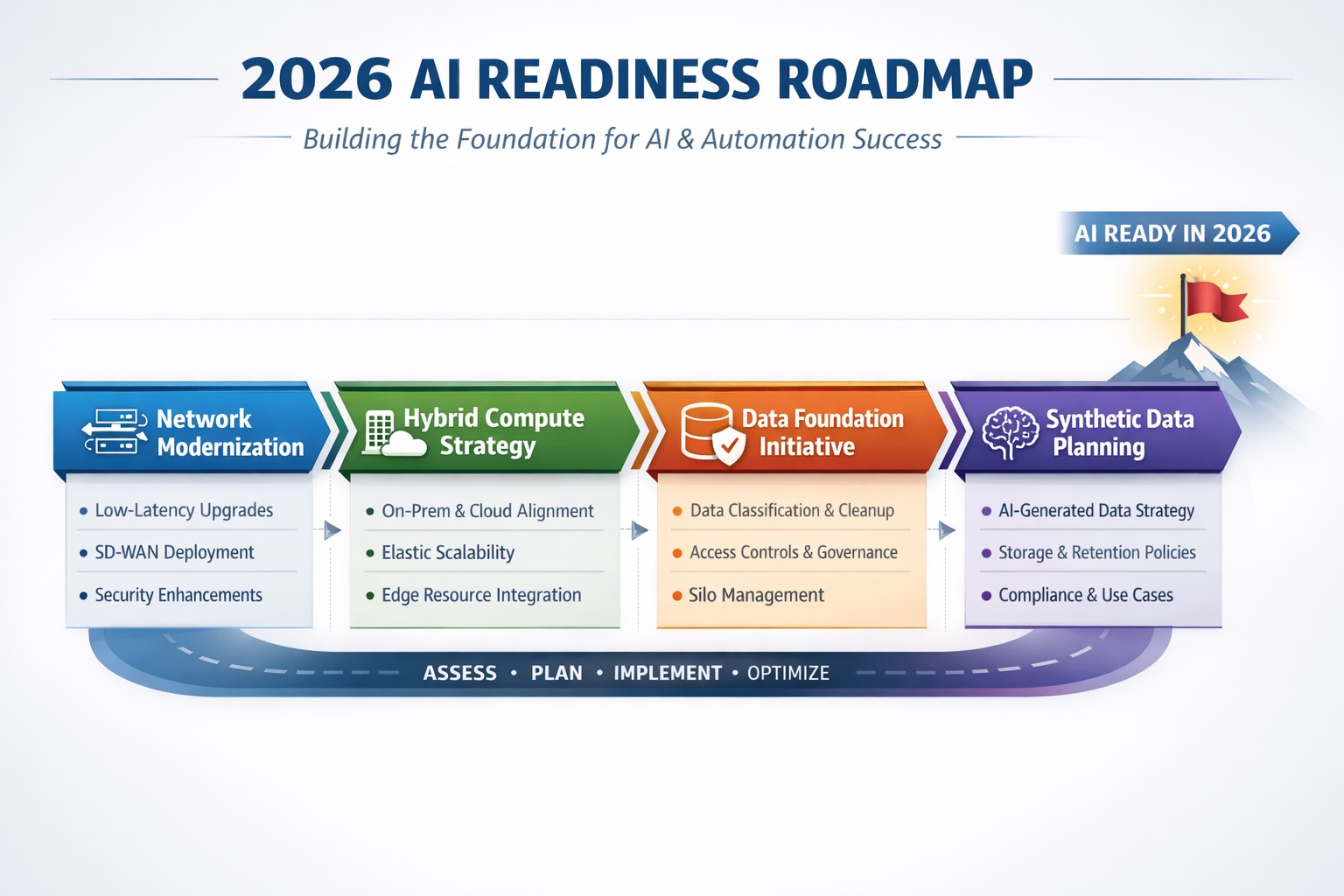
What does this translate to on a roadmap?
For business leaders, this preparation ultimately takes shape as a small set of well-defined, multi-year initiatives rather than one monolithic “AI project.” In practice, that often includes a network modernization program to reduce latency and eliminate bottlenecks, a hybrid compute strategy refresh that aligns on-prem, cloud, and edge resources to support bursty AI workloads, and a data foundation initiative focused on identifying high-value data sets, tightening access controls, and reducing sprawl. Increasingly, forward-looking teams are also beginning synthetic data planning—defining where AI-generated data will live, how it’s governed, and how it influences future automation. These are familiar IT motions, but viewed through an AI readiness lens, they become strategic enablers that compound value over time rather than one-off infrastructure upgrades.
Infrastructure and Data: The Fastest Path to Real AI Value
Trust, responsibility, and human oversight will always matter. They require leadership, policy, and culture. But infrastructure and data? Those are solvable—with planning, projects, roadmaps, and investment.
Organizations that prioritize these areas will be positioned to:
- Generate original insights from their own operations
- Automate complex workflows safely
- Solve problems that were previously out of reach
- Expand what’s possible without increasing risk
AI transformation doesn’t start with algorithms.
It starts with preparation.
As your technology partner, Morefield’s role is to help you make smart, practical decisions today—so AI becomes an advantage tomorrow, not an experiment that never delivers.
If 2026 is on your roadmap, now is the time to build the foundation.