
Over the past decade, the workplace has undergone dramatic transformation. Hybrid work, activity-based layouts, and the continued shift toward open architecture have improved collaboration and space utilization—but they’ve also intensified a long-standing challenge: distraction and speech privacy. With fewer physical barriers and more shared spaces, employees often struggle to focus while hearing conversations, typing, impromptu huddles, and even HVAC and building mechanical noise.
Today sound masking has evolved into a sophisticated acoustic privacy technology that blends advanced DSP processing, zoned control, and intelligent emitters to create a comfortable, productive acoustic environment. Rather than making the room louder, today’s systems generate a controlled, uniform background sound that reduces speech intelligibility and helps occupants concentrate without feeling isolated.
Let’s break down what modern sound masking is—and how it supports productivity in today’s connected workplace.
What Is Sound Masking?
In any open office or mixed-use space, audible distractions are inevitable. Human speech is particularly problematic: our brains are wired to decode language, so even conversations we don’t want to hear can hijack our focus.
Modern sound masking systems solve this by generating a precisely tuned audio spectrum—typically between ~200 Hz and 6 kHz, the same range where the intelligibility of human speech resides. But unlike the “white noise” of early systems, today’s masking solutions use adaptive, data-driven frequency curves that blend naturally into the environment.
Good masking should be felt, not heard—a subtle, neutral “whoosh” that reduces how far conversations carry, making unwanted speech fade into the background. Employees don’t experience silence; instead, they experience a balanced and controlled acoustic profile that supports productivity and comfort.
How Does Sound Masking Work?
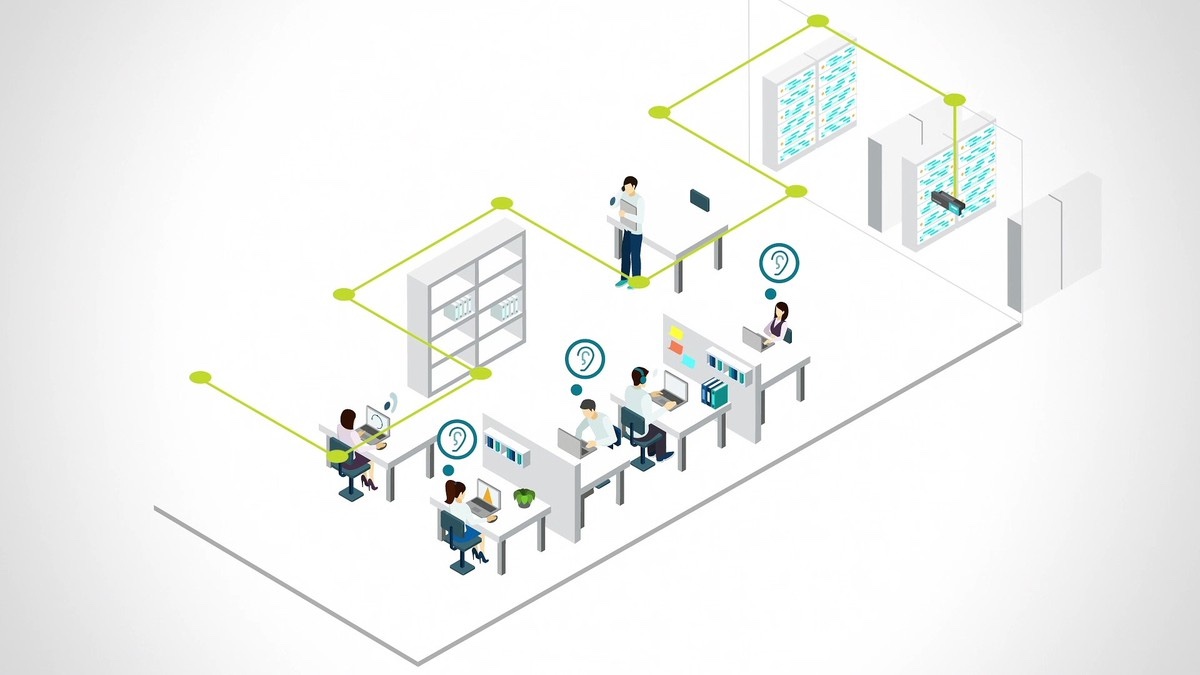
Today’s sound masking systems integrate:
Intelligent Emitters
Distributed speakers installed in a ceiling tile grid, plenum, or direct-field application. To ensure a seamless, even masking field across large spaces, modern emitters use:
- Wider dispersion patterns
- More consistent phase alignment
- Improved low-frequency performance
- PoE or low-voltage daisy-chain power
Digital Signal Processing (DSP) Engines
Contemporary systems incorporate:
- Adaptive EQ curves based on real-time ambient noise
- Time-of-day profiles
- Automatic gain control
- Zone-specific tuning
- Networked monitoring via secure dashboards
This allows each zone—open offices, huddle rooms, call centers, reception areas—to have independent masking levels tailored to the spaces acoustic requirements.
Speech Privacy Optimization
Masking reduces what we call the Speech Intelligibility Index (SII)—the measure of how far and how clearly speech can be understood. By decreasing intelligibility radius, conversations become nonsensical at short distances, which the brain quickly filters out.
Integration with Building Systems
Facility managers and AV teams are able to treat acoustics as a dynamic, manageable component of the work environment. Sound masking frequently integrates with:
- Paging and emergency notifications
- IoT sensors
- Smart building platforms
- Occupancy analytics
- WELL v2 acoustic performance standards
What Are the Benefits of Sound Masking?
Sound masking offers a wide variety of benefits with everything from security improvements to comfort:
- It can improve productivity and focus:A consistent masking field reduces distractions and helps employees remain in a “flow state.” Numerous workplace studies confirm that even brief interruptions can significantly degrade cognitive performance—sound masking reduces both the frequency and impact of these interruptions.
- Enhanced Workplace Comfort:Discomfort from intermittent noises, conversations, and unpredictable acoustic peaks is a major contributor to workplace dissatisfaction. Modern masking stabilizes the acoustic landscape, delivering a calm, consistent sound profile that supports well-being.
- Confidentiality & Speech Privacy: Modern masking systems are commonly deployed in environments where speech privacy is essential:
- HR and legal offices
- Healthcare (HIPAA-sensitive areas)
- Call centers and contact hubs
- Banks and credit unions
Masking ensures sensitive conversations stay private—critical in regulated industries.
- It offers flexibility: Today’s systems are adaptability for hybrid workplaces where layout changes are frequent.
- Per-zone tuning
- Per-emitter adjustments
- Direct-field or in-ceiling plenum options
- Seamless expansion as spaces evolve
- Software-based configuration and cloud monitoring
- It offers a fast return on investment: Sound masking begins improving focus and reducing distractions immediately upon deployment. For many organizations, the productivity gains, improved employee satisfaction, and reduced acoustic complaints deliver a rapid ROI—often within months.
Where Sound Masking is Commonly Used Today
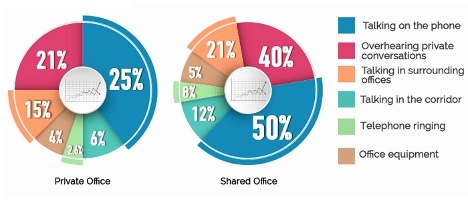
While still popular in open floor plans, masking has expanded into numerous environments as organizations recognize its value:
- Private offices: Thin walls and modern glass partitions often lack true acoustic separation. Sound masking ensures conversations remain private and reduces spillover between adjacent offices.
- Call centers & Customer Support Hubs: Many 2025 call centers operate in dense layouts with high agent conversation volume. Masking dramatically improves both employee comfort and caller experience.
- Healthcare: As masking helps prevent inadvertent disclosure of protected patient information. With HIPAA compliance and patient dignity drive widespread adoption of sound masking in:
- Hospitals
- Clinics and exam areas
- Pharmacies
- Behavioral health environments
- Waiting rooms and reception areas
- Financial institutions: Banks and credit unions leverage masking to ensure confidential conversation at teller stations, desks, and member service offices.
- Legal, HR, and Professional Services: Whenever privacy matters—interviews, performance reviews, client consultations—masking reduces risk and improves comfort.
Sound Masking is a Core Component of Workplace Design
Sound masking isn’t just an optional add-on—it’s a foundational component of workplace AV design. As layouts continue evolving toward open, adaptable, and collaborative architecture, masking provides the privacy, comfort, and acoustic control employees need to stay productive.
With modern DSPs, adaptive tuning, hybrid-work integrations, and expanded IoT capabilities, today’s sound masking systems deliver unmatched precision, flexibility, and reliability.
As you can imagine, an interconnected system like this can get a little complicated. Fortunately, Morefield can help. For our Central Pennsylvania clients we engineer sound masking systems that integrate quickly and easily, with minimal interruptions to your workday.
Morefield has been helping Central Pennsylvania businesses find the right technology solutions for over 80 years. Contact us today to learn more about a sound masking system that can help your employees work smarter.