

Whether you oversee a single office or an entire multi-building campus, physical security must remain a top operational priority. Your facility houses equipment, sensitive data, intellectual property, customer information, and—most importantly—your employees. Protecting these assets requires real visibility into what happens across your property, indoors and out.
Security teams can’t be everywhere at once, but today’s video surveillance systems can. Modern IP-based surveillance blends high-resolution cameras, smart analytics, cloud management, and secure storage to help organizations detect threats earlier, streamline investigations, and create safer workplaces. Ahead in this article, Morefield experts will break down contemporary systems and what you should consider when preparing for your environment.
How a Video Surveillance System Works
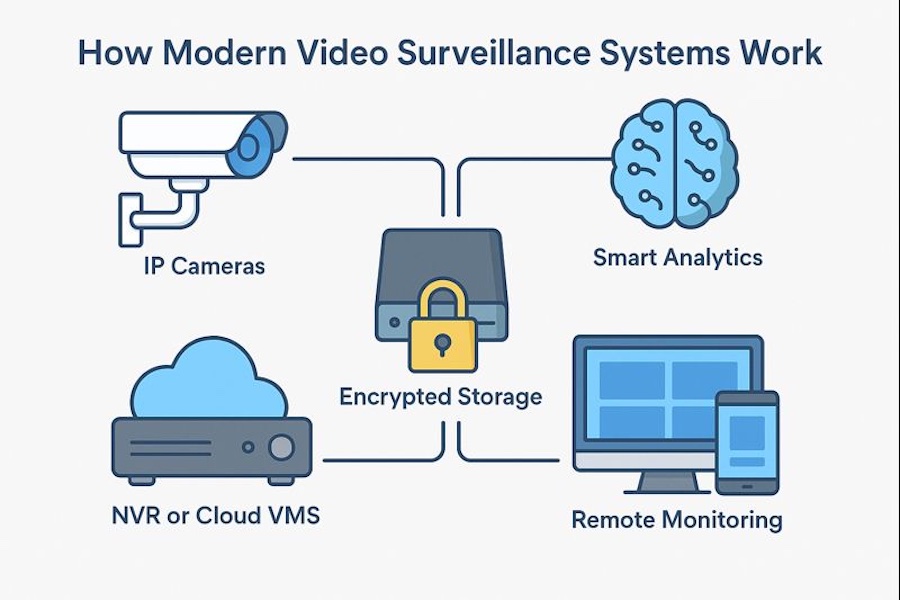
Today’s video surveillance solutions have evolved far beyond traditional CCTV. Instead of closed loops and analog feeds, modern systems are built around IP cameras and cloud accessible video recorders. Core components include:
- Cameras (single-sensor, multi-sensor, fisheye, PTZ, thermal, low-light, etc.)
- Network Video Recorders (NVRs) or Hybrid Cloud VMS Platforms
- Encrypted local or cloud storage
- Cloud AI engines which provide Smart analytics
- User friendly dashboards & mobile apps for remote monitoring
These systems provide live and recorded video accessible securely from anywhere, deliver intelligent alerts, and integrate with access control and building management systems.
What Today’s Analytics Can Do
AI-powered video analytics now play a central role. These intelligent capabilities help organizations reduce risk, speed up incident response, and even optimize workflows such as staffing, retail layout, and parking management. Well-configured systems can alert security or operations teams to:
- Human and vehicle detection
- Unusual behavior patterns
- Loitering or perimeter breaches
- Line crossing or restricted-area entry
- Slip-and-fall detection (some platforms)
- Abandoned or removed objects
- Occupancy counting and heat-mapping
- License plate recognition (LPR/ANPR)
Safety Benefits Beyond Security
Video surveillance supports emergency response. Real-time location awareness, occupancy dashboards, and forensic playback can help first responders understand where people are located during evacuations or critical events.
Designing a Surveillance System for Today’s Environments
A modern video system is far more than the mechanical “pull some cables, mount a few cameras and hit record.” To achieve long-term value, you need a design tailored to your facility, infrastructure, and operational goals.
When you work with a professional integrator like Morefield, we will consider the following.
Define the System’s Purpose and Priorities
Organizations adopt video surveillance for many distinct reasons. Start by defining the highest-value outcomes for your deployment:
- Deterring theft or unauthorized access
- Monitoring critical areas such as server rooms or cash-handling spaces
- Gaining situational awareness across large campuses
- Supporting safety and compliance initiatives
- Improving traffic flow or employee productivity
- Reducing investigation time and liability costs
- Integrating video with access control or intrusion alarms
The clearer your objectives, the more precisely Morefield can help you match camera types, resolutions, and analytics features to your needs.
Conduct a Thorough Site Survey
A detailed site survey is essential—this is where most successful projects are won. A modern survey includes assessing:
- Existing network infrastructure: switch capacity, PoE, cable, VLAN needs
- Environmental conditions: lighting, weather, vibration, temperature swings
- Physical constraints: ceiling height, mounting surfaces, conduit routing
- Existing systems: analog cameras that may need migration or hybridization
- Operational risk zones: areas where loss, liability, or safety concerns are highest
Common priorities that Morefield encounters include:
- Building entrances/exits
- Parking lots, garages, and perimeter fencing
- Reception and waiting areas
- Shipping/receiving docks
- IT closets and data centers
- Cash handling, financial processing, and records
- High-value equipment rooms
- Elevators and stairwells
- Remote or poorly lit areas
As a professional installer, the Morefield ProServices team will evaluate light challenges (glare, backlighting), your required field of view, and optimize frame rates to ensure the captured video is usable during an investigation.
Select the Right Cameras for Each Location
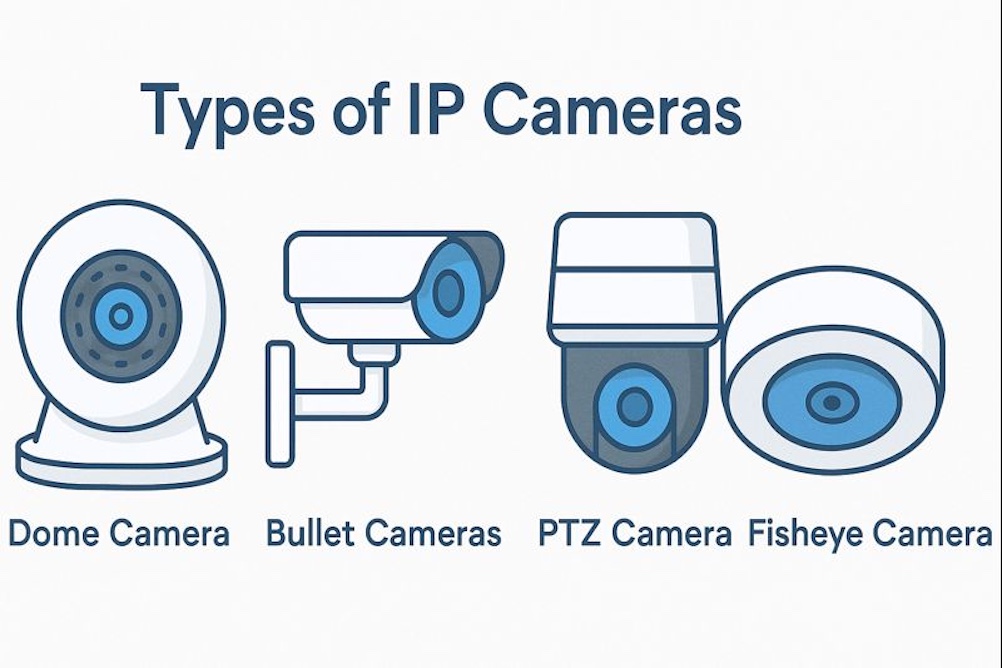
Different environments require different camera technologies. Today’s IP camera families include:
Single-Sensor Cameras
- Best for hallways, focused views, controlled lighting
- Cost-effective and simple to install
- Available in fixed dome, turret, or bullet formats
Multi-Sensor or Multi-Directional Cameras
- Provide 180° to 360° coverage from one mounting point
- Dramatically reduce blind spots
- Useful in lobbies, warehouse corners, parking lots
- Often more cost-effective than installing multiple single cameras
PTZ (Pan-Tilt-Zoom) Cameras
- Ideal for active monitoring by security officers
- Excellent for wide-area surveillance such as campuses or production yards
- Powerful optical zoom for long-distance identification
Specialty Cameras that are engineered for a specific application:
- Fisheye 360° cameras for complete room coverage
- Thermal cameras for perimeter breaches and low-visibility conditions
- Low light | starlight cameras for nighttime clarity
- LPR | ANPR cameras for vehicle identification
- Explosion-rated cameras for hazardous industrial zones
Resolution Considerations
Higher resolution, more MP (mega-pixels) doesn’t automatically mean better results—but resolution must match the goal:
- 2–4 MP: General surveillance, wider angles, cost-efficient
- 6–8 MP: Improved detail for facial features, identifying individuals
- 12–20 MP (or multi-sensor equivalent): Large areas requiring forensic-level detail
- Thermal resolution: Based on detection vs identification needs
Morefield’s surveillance professionals will account for lens selection, compression settings, low-light performance, and bit-rate management to ensure storage retention meets requirements without unnecessary cost.
Work with a Surveillance Expert
Planning for a new system installation can feel daunting, especially if you have strict security requirements or a lot of area to cover. When you work Morefield our surveillance experts, will ensure you get a system tailored to your needs.
At Morefield, we have more than 80 years of experience helping Central Pennsylvania organizations protect their assets with integrated physical security solutions. We can implement video surveillance systems skillfully and efficiently to provide the best results. If you’re ready to start planning your new system, reach out to us today.