



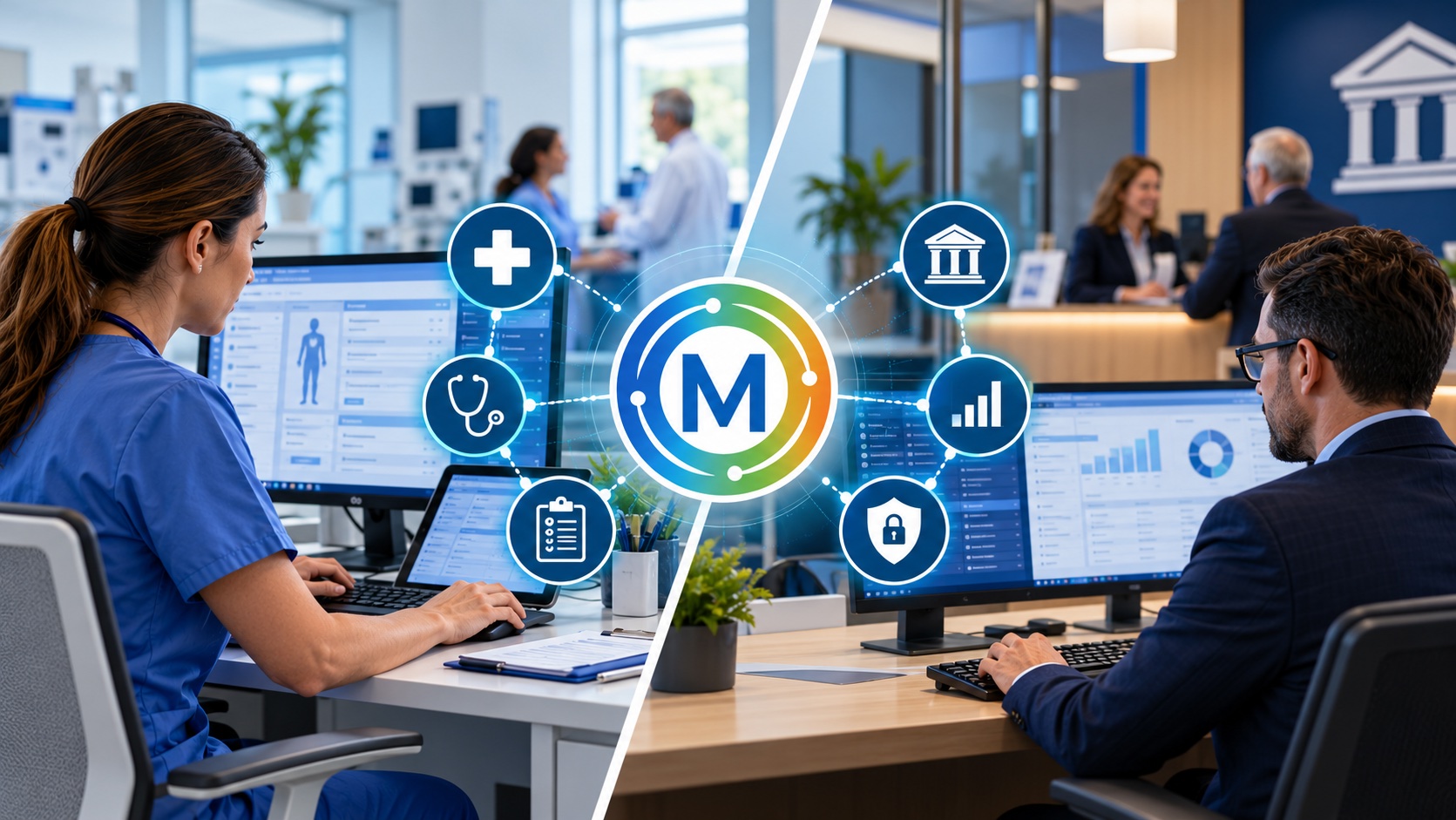
Technology plays a critical role in nearly every business, but for healthcare practices, credit unions, and community banks, the stakes are particularly high. A network outage at a medical office can interrupt patient care. A technology failure at a financial institution can prevent members or customers from accessing essential banking services. A cybersecurity incident in either industry can expose sensitive information, disrupt operations, and create regulatory consequences.
These organizations need more than responsive technical support. They need a managed service provider (MSP) that understands the relationship between technology, operational continuity, security, and regulatory responsibility.
While healthcare and financial institutions share many technology challenges, their environments and priorities are not identical. Understanding those differences is an important first step in selecting the right managed IT partner.
Most businesses depend on reliable networks, secure data, and functioning applications. Healthcare and financial organizations face additional responsibilities because of the sensitive information they manage and the essential services they provide.
Healthcare providers must protect patient information, maintain access to electronic health records (EHRs), and support clinical applications and connected medical technology.
Credit unions and community banks face similar responsibilities involving financial information, but often with the added complexity of branch operations, core banking platforms, payment processing, and third-party financial technology providers. A disruption affecting one system can have consequences across multiple branches.
Both industries operate under regulatory requirements that influence how technology must be managed.
Healthcare organizations must address applicable HIPAA requirements, while credit unions and community banks operate under PA department of banking, financial regulations and supervisory expectations.
An MSP can help implement safeguards, manage technology risks, and support compliance activities. However, outsourcing IT does not transfer an organization’s regulatory responsibilities to its service provider. The goal is to establish a technology program that supports operational motions while helping leadership manage security, compliance, and business risk.
Although the underlying technologies may be similar, their applications and business consequences can be quite different.

These differences matter when evaluating an MSP. A provider may have extensive experience managing business workstations but limited familiarity with clinical applications, core banking platforms, or multi-location infrastructure.
For community-based financial institutions in particular, technology reliability often depends on coordinating several interconnected systems and vendors. Industry experience helps your MSP recognize these dependencies and prioritize technology decisions around essential business operations.
Rather than comparing providers solely by the number of services included in a monthly subscription, healthcare and financial leaders should evaluate how the MSP will support their broader environment.
Reliable technology requires continuous attention, not simply a response when something breaks. Proactive monitoring and maintenance are important components of reducing technology outages and operational risk, particularly for organizations where even short interruptions can affect essential services.
An effective managed IT program includes system monitoring, patch management, device administration, and regular maintenance. These activities help identify potential problems before they interrupt operations.
For a credit union or bank with several branches, consistent management across locations can reduce the risk of individual systems being overlooked. For medical practices, proactive maintenance helps support dependable access to clinical applications and patient information.
Both industries face cybersecurity threats involving sensitive information, employee credentials, and essential applications. Look for an MSP that incorporates foundational protections such as endpoint security, multifactor authentication, email security, and employee security awareness training.
Depending on the organization’s risk profile, additional capabilities may include managed detection and response, vulnerability management, security assessments, and Governance, Risk, and Compliance Support.
Organizations should understand exactly what monitoring, incident response, reporting, and compliance assistance are included, and which capabilities require additional services.
Preventing disruptions is important, but organizations must also prepare for situations where unexpected incidents disrupt your operations. A suitable MSP should help establish documented backup and recovery processes, identify critical applications, and define realistic recovery objectives.
For a medical practice, priority systems may include EHRs and patient scheduling. For a credit union or community bank, they may include core banking platforms, transaction systems, and branch connectivity.
Financial institutions also depend on third-party providers for essential services. Business continuity planning should address these dependencies, including how the institution will communicate and continue serving members or customers during an extended vendor outage.
Backups alone are not sufficient. Organizations should understand how recovery processes are tested, who coordinates restoration, and how operations will continue during a significant disruption.
Many technology problems can be resolved remotely, making centralized help desks and remote monitoring valuable components of managed IT. However, some problems require someone who is physically present at your Central PA office.
Consider a community bank experiencing intermittent network connectivity at one of its branches. The issue could involve a carrier circuit, firewall, network switch, or physical cabling. Resolving the problem may require both advanced network expertise and an on-site technician.
For credit unions, community banks, and healthcare organizations operating locations throughout Central Pennsylvania, access to local technical resources can be particularly valuable. When evaluating an MSP, ask whether it maintains local technicians, how on-site service is coordinated, and what happens when a critical problem occurs outside normal business hours.
A provider’s ability to respond locally can complement its remote support capabilities and reduce the complexity of resolving infrastructure problems.
An MSP typically manages an organization’s existing technology environment. But who designs, builds, and upgrades that environment? This question is particularly relevant when a credit union opens or renovates a branch, consolidates locations, or modernizes aging infrastructure.
Reliable branch operations may require network architecture, structured cabling, secure WiFi, carrier connectivity, and physical security systems. These technologies must function together to support employees, transactions, and member services.
Healthcare organizations face similar considerations when expanding practices or implementing new clinical technology.
An MSP with broad engineering capabilities helps organizations plan and implement infrastructure improvements, then assumes responsibility for ongoing management. This continuity between design, implementation, and support simplifies vendor coordination and helps to ensure infrastructure decisions align with long-term operational requirements.
Technology decisions should not be driven exclusively by equipment failures, urgent support requests, or unexpected expenses. A strategic MSP relationship includes regular technology reviews, equipment lifecycle planning, budget forecasting, and recommendations aligned with business objectives.
For community banks and credit unions, these activities can support annual budgeting, capital planning, and a disciplined approach to addressing aging infrastructure across branches.
Healthcare organizations benefit from similar planning as clinical systems evolve and security requirements change.
The objective is not simply to spend less on IT. It is to make informed investments that improve reliability, reduce risk, and support future growth.
Not every healthcare provider or financial institution needs the same service arrangement.
A smaller medical practice or community financial institution with limited internal IT resources may benefit from a fully managed program covering everyday support, monitoring, maintenance, and foundational security.
A growing, multi-location organization may require additional security services, infrastructure management, vendor coordination, and more formal recovery planning.
Credit unions and community banks with established IT personnel may prefer a co-managed approach, retaining internal ownership of core systems and strategic responsibilities while leveraging an MSP for network management, specialized engineering, cybersecurity, or operational support.
The right model depends on organizational size, internal resources, technology complexity, and acceptable levels of operational risk. Organizations with more complex environments need to Evaluate Specialized Managed IT Solutions beyond foundational services, particularly when addressing regulatory requirements, security risks, and multiple locations.
Before committing to a provider, leaders should understand how the proposed partnership will work in practice.
These conversations can reveal important differences between providers offering similar-looking managed service packages.
For healthcare organizations, credit unions, and community banks, the value of managed IT extends beyond keeping computers running. It is about protecting essential operations, managing risk, and building a dependable technology foundation.
Morefield works with organizations throughout Central Pennsylvania, combining locally delivered IT support, specialized engineering expertise, and strategic technology guidance. Our ability to design, implement, and manage technology infrastructure allows us to support clients throughout the technology lifecycle—not simply after systems are installed.
The right MSP should help your organization operate confidently today while preparing its technology environment for tomorrow.