



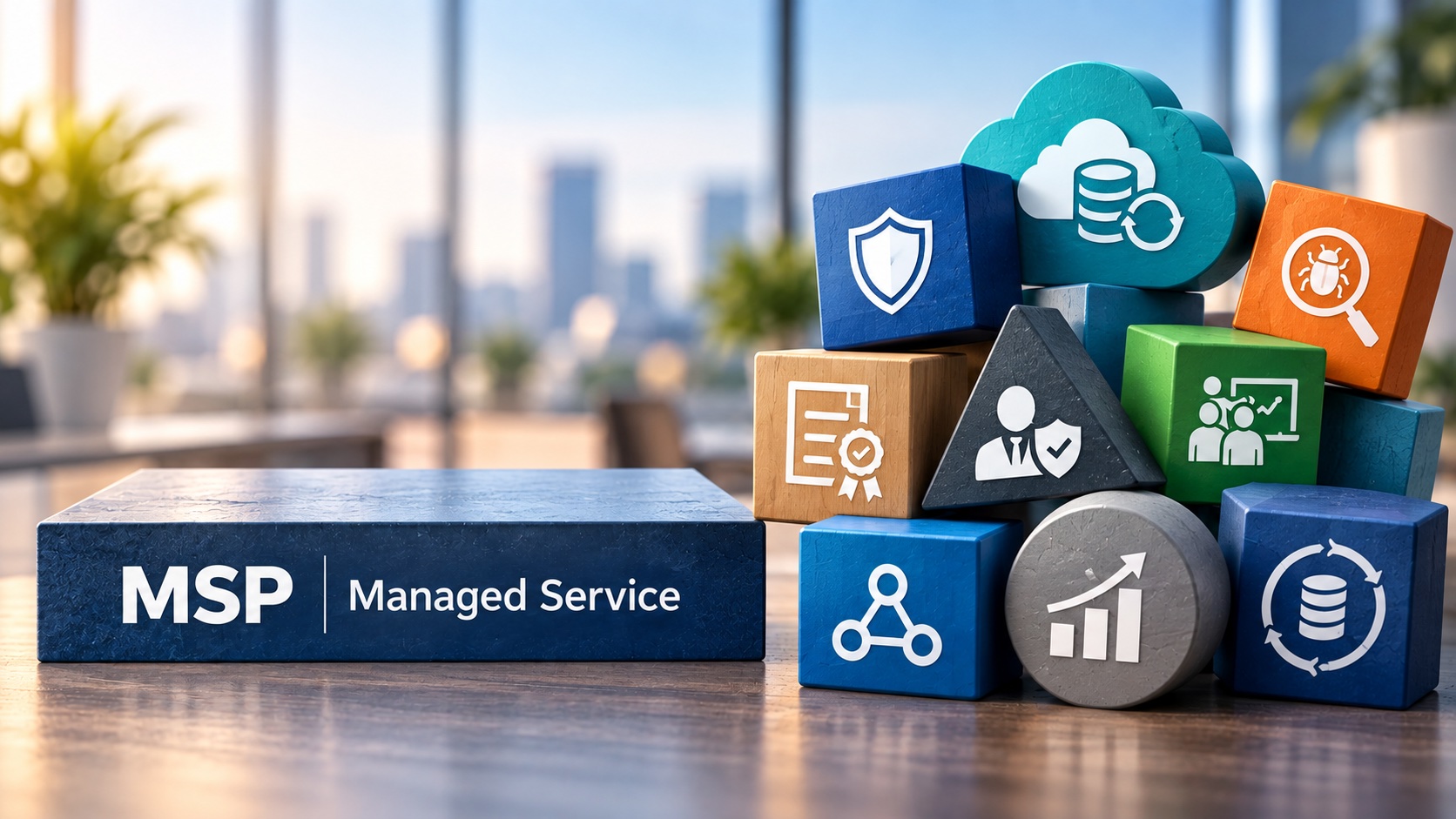
Managed IT for regulated businesses requires more than traditional technology support. Healthcare providers must protect patient information. Financial institutions must demonstrate appropriate safeguards and oversight. Other regulated organizations face similar requirements for protecting sensitive information, managing risk and documenting compliance.
For organizations within these industries with multiple locations, those responsibilities become even more complicated. The technology must work, be consistently managed, secured and documented across the entirety of the organization.
A traditional Managed Service Provider (MSP) program will provide you an important foundation. Included services such as help desk, endpoint management, network monitoring, patching and Microsoft 365 management all help to keep your IT environment operating reliably.
But regulated organizations, like Healthcare need capabilities beyond foundational IT.
Increasingly, these capabilities are available as managed solutions: specialized services delivered and managed by your MSP under a recurring basis. Rather than hiring additional internal specialists or purchasing another tool that employees must manage themselves, organizations can add specific capabilities based on their risks, regulatory requirements and business needs.
Before comparing individual solutions, it helps to understand (3) related responsibilities that influence technology decisions in regulated organizations.
Governance establishes the policies, procedures and accountability that guide how security is managed throughout the organization. This includes security policies, incident response planning, employee responsibilities and processes for reviewing and improving security practices.
Risk management identifies potential threats to systems, data and operations. Vulnerability assessments and analysis of business workflows help organizations understand where weaknesses exist, the potential impact of those weaknesses and which risks should be addressed first.
Compliance focuses on meeting applicable regulatory and security requirements. Depending on the organization, this might include HIPAA, financial regulations or recognized cybersecurity frameworks. Compliance will require organizations to demonstrate that the appropriate policies, safeguards and processes are actually in place.
These responsibilities overlap, but they are not interchangeable. Passing a compliance review does not necessarily mean an organization has eliminated its cybersecurity risks. Likewise, deploying additional security technology does not automatically create effective governance.
The right combination will vary based on the organization’s industry, internal resources, technology environment and risk profile. For a multi-location regulated organization, additional managed solutions deserve consideration.

Cybersecurity is increasingly becoming a core component of the MSP relationship rather than a separate technology project.
Particularly important when employees work from multiple facilities, remotely or while traveling.
A managed cybersecurity program combines endpoint protection, monitoring, threat detection, security management and response capabilities into an ongoing service. The advantage for a regulated organization is consistency with security controls deployed across users, devices and locations rather than relying on individual offices to maintain them.
Backup answers an important question: Can we recover our data? Business continuity takes that question further: Can we continue operating when something fails?
Managed backup and business continuity/disaster recovery (BCDR) solutions provide centralized backup, monitoring, testing and recovery planning across multiple systems and locations.
For regulated organizations, the ability to demonstrate that backups exist is only part of the equation. Organizations should understand where backups are stored, how frequently data is protected (RPO), how quickly systems can be recovered (RTO) and whether recovery procedures are regularly tested.
Security tools protect an environment, but organizations need a way to identify weaknesses before the weakness is exploited.
A vulnerability assessment provides a point-in-time evaluation of systems and devices, identifies specific risks and root causes, and creates remediation recommendations. More comprehensive cybersecurity assessments can expand that analysis to include organizational risk, the threat landscape and alignment with frameworks such as the NIST Cybersecurity Framework.
For many organizations, the next step is turning assessment into an ongoing process. Regular vulnerability management provides visibility into new risks as systems, applications and threats evolve.
Compliance can become particularly difficult when responsibility is spread across IT, operations, leadership and outside vendors.
A managed Governance, Risk and Compliance (GRC) solution provides structure around those responsibilities. It can help an organization establish policies, document controls, identify gaps, track remediation and maintain evidence required for regulatory or security reviews.
The value isn’t simply preparing for an audit. A mature GRC program creates an ongoing process for connecting business risk, cybersecurity practices and organizational accountability.
When an organization needs security leadership but cannot justify the resources for a full-time Chief Information Security Officer, a virtual CISO (vCISO) provides access to that capability as a managed service.
The scope can extend well beyond occasional consulting. For example, a vCISO service may assist with policies, controls and standards; ongoing vulnerability assessments; threat intelligence; incident-response tabletop exercises; business continuity testing; security awareness; and reporting to senior leadership.
For regulated organizations, the benefit is having someone responsible for connecting individual security activities into a broader strategy.
Employees routinely interact with email, cloud applications, sensitive information and external organizations. Security awareness programs help employees recognize phishing, social engineering and other common threats while reinforcing their responsibilities for protecting information.
Technology alone cannot address every security risk.
For multi-location organizations, a managed program delivers consistency. Training, testing and reporting can be coordinated across all offices rather than relying on each office or department to develop their own approach.
The network connects every component of the IT environment, making it especially important for organizations operating multiple locations.
A managed network can provide centralized management of firewalls, switching, wireless networks, internet connectivity and secure connections between facilities. Standardizing those environments can make them easier to monitor, secure and support.
It gives the organization greater visibility into whether the same security standards and configurations are being applied across every office.
This may be the most useful question to consider for an organization evaluating managed solutions.
A multi-location physician practice, financial institution or other regulated business may need cybersecurity expertise, vulnerability management, compliance guidance, backup administration and security leadership. That does not necessarily mean it needs to hire a separate employee for each responsibility.
Managed solutions allow organizations to acquire the capability without necessarily adding the position.
This model can be particularly valuable when specialized expertise is only required for a portion of the week or month. The MSP provides the people, technology and processes necessary to deliver the outcome while the organization maintains oversight and accountability.
There isn’t one managed IT package that is appropriate for every regulated organization.
Start instead with the organization’s risks and obligations. What information needs to be protected? Which regulations or frameworks apply? What happens if a critical system becomes unavailable? Which security capabilities already exist internally? Where are responsibilities unclear or expertise limited?
From there, evaluate what the existing MSP program already addresses and identify the gaps that require additional capabilities.
For some organizations, that may mean strengthening cybersecurity and backup. Others may need formal vulnerability management, GRC or virtual CISO services. Multi-location organizations may benefit most from creating greater consistency across networking, security and business continuity.
The goal isn’t to purchase more IT services. It is to build a managed technology program in which each solution addresses a defined business risk, regulatory requirement or operational need.
Not sure where to go next? Use our Find Your Solution tool to tell us about your environment, security and compliance requirements, and IT challenges. We’ll help you identify where managed services or specialized solutions may fit.