


October is Cybersecurity Awareness Month, making it a good time for organizations to consider how they protect against cyber threats, and to reflect on whether they are adequately prepared to prevent technology problems from disrupting the operation.
Cybersecurity and business continuity are increasingly connected. A ransomware attack that makes critical files unavailable is both a security incident and an operational disruption. An unpatched vulnerability can become downtime if it is exploited. A failed backup can turn a manageable technology problem into an extended business outage.
Good cybersecurity practices are part of a larger operational objective: keep your systems available, detect problems early and recover quickly when something goes sideways.
Managed IT services cannot eliminate downtime or guarantee that a business will never experience a cybersecurity incident. What they can do is reduce technology problems from becoming serious business disruptions, limiting their duration and impact when they occur.
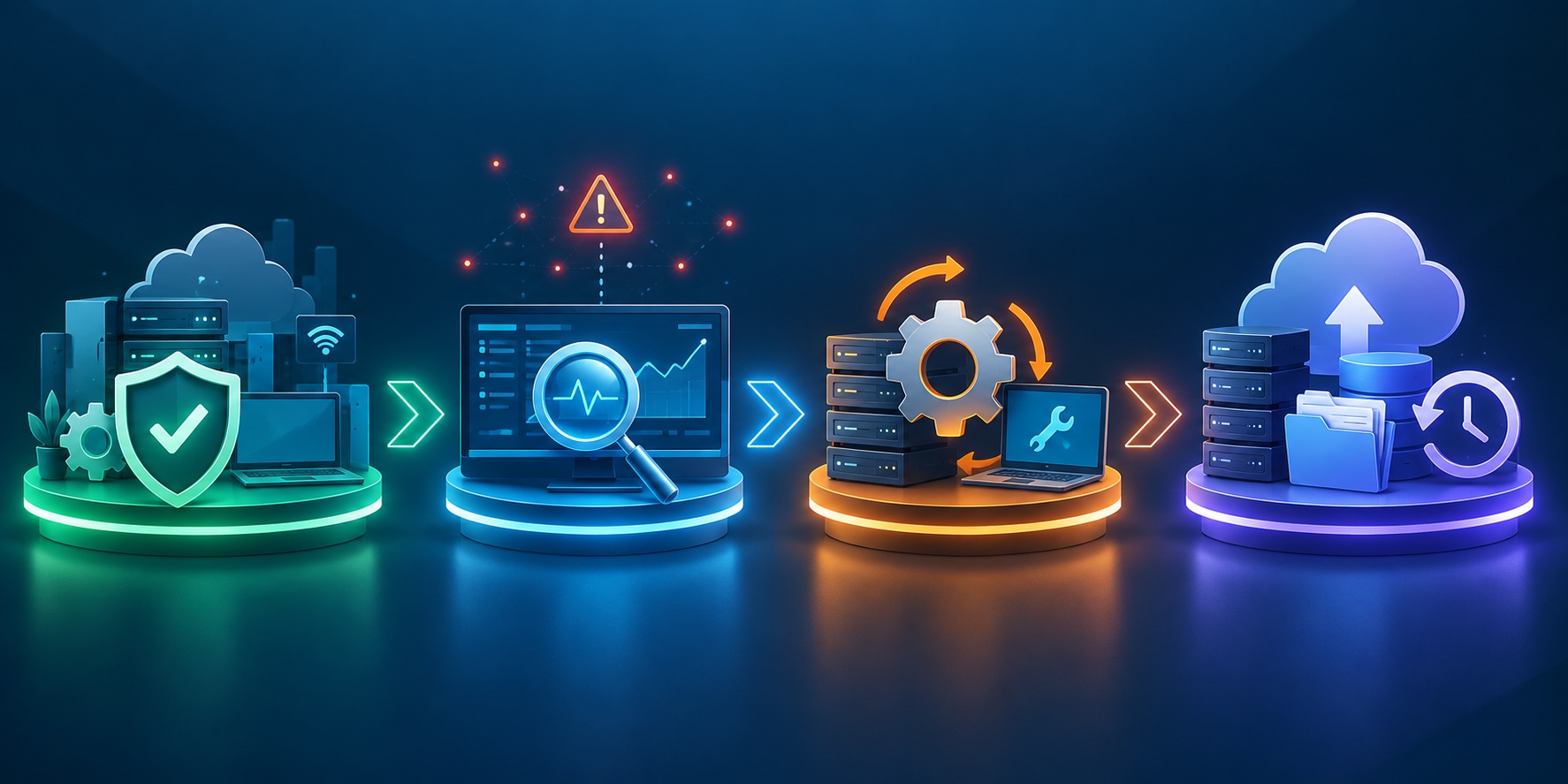
A mature IT program shifts from a reactive model of fixing problems when they occur towards a continuous cycle of prevention, detection, response and recovery.
Some technology failures arrive without warning. Others provide an opportunity for intervention before employees are affected.
Preventive maintenance is one of the fundamental differences between reactive IT support and a managed IT program. Rather than waiting for something to fail, systems are routinely maintained through activities such as patch management, software updates, configuration management and hardware health checks.
Software vendors regularly release patches addressing known security vulnerabilities. When those updates are not applied consistently, organizations remain exposed to vulnerabilities that attackers already know how to exploit. Endpoint security, DNS and web filtering, multifactor authentication (MFA) and security awareness training provide layers of protection designed to prevent an incident or limit the exploit opportunity from occurring.
Prevention requires knowing what needs to be protected. Maintaining an accurate inventory of devices, systems and applications provides greater visibility into the environment and helps ensure that systems aren’t inadvertently overlooked.
Remote monitoring allows an MSP to continuously watch critical infrastructure, whether onsite or in the Cloud. Monitoring infrastructure that includes servers, networks, endpoints and storage systems for failures, performance problems and unusual behavior. Instead of relying solely on an employee to recognize a problem and submit a support request, monitoring tools can automate and generate an alert when predefined conditions are detected.
Early detection can change the timeline of an incident significantly.
Consider a server beginning to run out of available storage. Without monitoring, the first indication of a problem may be when an application stops working. With appropriate monitoring and alerting, the condition can be identified and addressed before employees experience an outage.
Cybersecurity monitoring applies the same principle. Endpoint detection and response tools can identify suspicious behavior on a device and help contain a threat before it spreads elsewhere in the organization.
A useful question to ask about your managed IT relationship: Who usually identifies the problem, your employees or your IT provider?
Users will inevitably discover issues, but if nearly every technology problem begins with an employee reporting that something isn’t working, your organization may not be realizing the full benefit of a proactive managed service program.
When an incident occurs, a defined support and escalation process helps move the problem to the appropriate technical resource without delay. A dedicated Service Desk provides employees with a consistent place to request assistance, while dispatch and escalation procedures help route more complex issues to senior engineers with the appropriate expertise.
What initially appears to be an application problem, for example, might ultimately involve the network, a cloud service, an endpoint or a security control. Access to a broader team of specialists gives an MSP the ability to escalate an issue rather than relying on one person to understand every component of the environment.
Cybersecurity incidents make this coordination even more important. A documented incident response process defines how an organization will contain, investigate and recover from an event instead of determining those steps amongst the chaos of a crisis.
Early detection becomes particularly important when an incident crosses technology disciplines.
Speed matters because the impact of an incident often increases with time. The faster the appropriate resources can identify the cause, contain the problem and begin remediation, the less disruptive the event is likely to become.
Eventually, every organization should assume that some preventive controls will fail.
Hardware fails. Software breaks. Employees make mistakes. Internet and cloud providers experience outages. Cybercriminals occasionally get through security controls.
At that point, resilience becomes less about preventing the incident and more about the organization’s ability to recover from it.
Backup and Disaster Recovery are essential parts of that strategy, but simply having a backup is not enough. Backups should be monitored, failures should be addressed and organizations should understand how their critical systems would be restored.
Two important concepts are the Recovery Point Objective (RPO) and Recovery Time Objective (RTO). RPO helps define how much data an organization could potentially lose following an incident, while RTO addresses how quickly a system needs to be restored.
Those expectations should be understood before an outage occurs—not discovered while employees are waiting for systems to come back online.
A mature managed IT program will ask: Can we reliably recover the business systems we depend on within an acceptable amount of time?
The Value of Managed IT shouldn’t be measured by the number of support tickets closed each month. Organizations should consider whether their IT program is becoming more resilient over time. There are several practical ways to evaluate that.
Are technology problems being detected before employees report them? How quickly are incidents acknowledged and resolved? Are operating systems and applications consistently patched? Are backups completing successfully, and are restores periodically tested? Are recovery objectives defined for critical systems? Are the same problems repeatedly generating support requests, or are recurring issues being identified and addressed at their root cause?
More technical measurements can provide additional insight. Mean Time to Detect (MTTD) measures how quickly an incident is identified, while Mean Time to Resolve (MTTR) helps quantify how long it takes to restore normal operation. Patch compliance, backup success rates, restore testing and system uptime can provide additional indicators of how effectively the environment is being managed.
No single metric tells the entire story. Collectively, they answer the larger question: Is our managed IT program actually reducing operational risk?
The goal of managed IT services isn’t to promise that technology will never fail.
It is to create layers of protection and support so that fewer problems become serious incidents. And the incidents that do occur are detected earlier, contained faster and recovered reliably.
Multiple layers require more than a help desk. They require ongoing system monitoring, preventive maintenance, cybersecurity controls, responsive support, access to specialized expertise and a defined approach to backup and recovery.
For business leaders, the distinction is important. The real value of managed IT isn’t simply having someone available to fix technology when it breaks.
It is reducing the likelihood that a technology problem becomes a business disruption in the first place.