


With mobile phones, Microsoft Teams and other modern communication tools available to employees, overhead paging might seem like a technology that businesses no longer need. Walk through a manufacturing plant, warehouse, retirement community or other large facility, however, and the need quickly becomes apparent.
Employees may not always be sitting near a phone or computer. Visitors and residents may not have access to company communication systems. And when an organization needs to locate an individual, make a general announcement or communicate an urgent message, everyone within the facility may need to receive the information at the same time.
Overhead paging continues to fill that role.
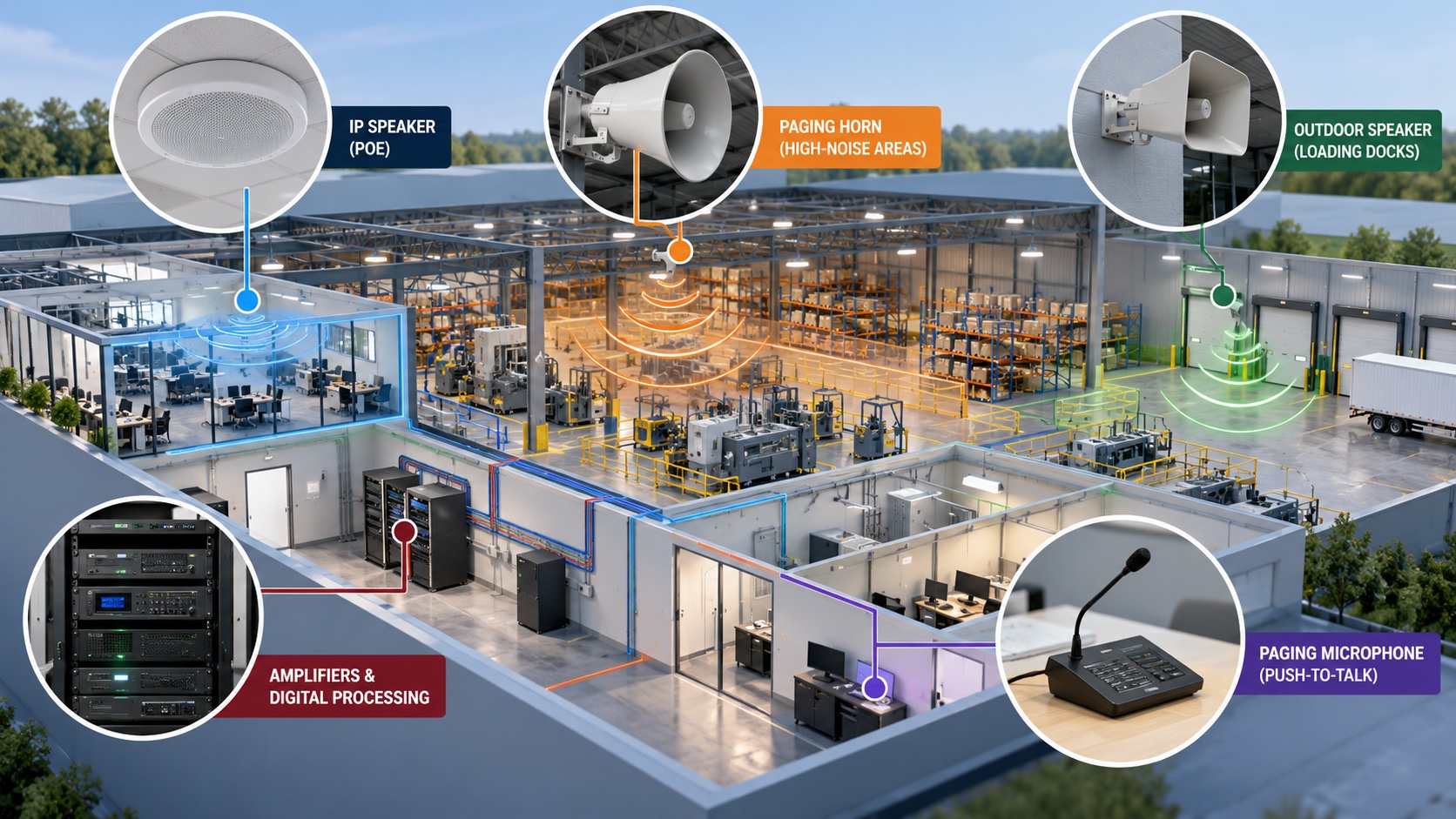
What has changed are the options available to organizations. Self-contained IP speakers can make it relatively easy to add paging to a facility using the existing network. At the other end of the spectrum, an engineered paging system can provide coordinated coverage across thousands of square feet.
Neither approach is inherently better. The question is which approach fits your building, your environment and your organization’s communication requirements.
An IP speaker is a network-connected endpoint designed to receive and broadcast audio. Unlike a conventional speaker that requires an external amplifier, IP speakers include their own amplification and intelligence and are powered using Power over Ethernet (PoE).
IP Speakers are particularly attractive when paging in a specific area.
For example, a business might have an office with an attached loading dock or small warehouse. Rather than installing a dedicated paging horns, an amplifier, speaker cabling and other supporting infrastructure, an IP speaker can be mounted in the space and quickly connected to the network and then integrated with the phone or communications platform.
Modern IP speakers offer considerably more functionality than simply playing audio. Depending on the endpoint and platform, capabilities can include SIP integration with a phone system, multicast paging, prerecorded announcements, emergency notifications, automatic volume adjustment based on ambient noise and even two-way communication.
Network-based paging systems can be configured to operate within zones that allow an announcement to be directed to specific area instead of the entire facility.
As a result, a solution with IP speakers can be a flexible and a cost-effective way to introduce paging or extend it into areas where coverage is needed.
The decision becomes more complicated as the environment does. Consider a large manufacturing facility. One area may contain relatively quiet offices with eight-foot ceilings. Another may have 30-foot ceilings, production machinery and employees wearing hearing protection. The warehouse could contain tall storage racks that affect how sound travels, while loading docks or outdoor spaces introduce entirely different acoustic conditions.
Simply making a page louder doesn’t necessarily solve those problems.
The objective is intelligibility: people need to clearly understand the message, not merely hear that an announcement is being made.
Designing for intelligibility can require evaluating Room Acoustics, ambient noise, ceiling height, building materials, speaker mounting locations, equipment and shelving, desired coverage patterns and changes in noise levels throughout the day.
That is where paging becomes less about selecting an endpoint and more about engineering a mass notification system.
Both approaches can provide effective paging, and both can incorporate modern IP communications. The differences are in how the system is designed, powered, connected and scaled.

One important distinction is what this comparison doesn’t say.
IP paging is not limited to small buildings. Multicast technology allows IP audio to be distributed to large numbers of endpoints, and modern paging platforms can coordinate speakers across zones, buildings and even multiple locations.
Likewise, an engineered paging system does not necessarily mean using outdated analog technology. Modern engineered systems can incorporate digital signal processing, network management, IP-based controls and integrations with unified communications platforms.
The decision is therefore less about “old versus new” and more about the communication environment
Facility size is certainly a consideration, but square footage alone shouldn’t determine the architecture.
A better starting point is to consider the complexity of the environment.
An engineered approach may make sense when a facility has significantly different ambient noise levels, high ceilings, production equipment, large warehouse spaces, multiple floors or outdoor areas. Different types of speakers may be required for different spaces, along with varying amplification and placement.
The number and purpose of paging zones also matter. A facility may need the ability to page an individual department, production area or floor without interrupting everyone else. Emergency messages, meanwhile, may need to reach the entire building.
Existing infrastructure is another consideration. Organizations sometimes reach a point where an aging paging system has missing or failed speakers, inconsistent volume or areas without coverage. Adding individual speakers over time may address isolated problems without resolving the larger issue.
At that point, continuing to patch the system may be less effective than stepping back and evaluating what the facility actually needs.
An engineered paging project should begin with the environment and desired outcomes rather than a list of products. Among the questions that should be considered are:
The answers influence speaker type, placement, wattage, amplification, processing, cabling and controls. These variables are why complex paging projects often benefit from working with an AV Integrator that can evaluate the physical environment before selecting and installing equipment.
Morefield designs and installs engineered paging solutions throughout Central Pennsylvania. We have been trusted with this complex work for decades, supporting environments ranging from schools and multi-story hospitals to CCRCs, warehouses and production facilities.

Each presents different challenges that our team must work through with creativity and applied expertise from changing ambient noise and ceiling heights to multiple floors, paging zones and integration requirements. Our experience allows the design process to begin with how people use the facility and where communication needs to occur, rather than simply determining how many speakers are needed.
One of the advantages organizations have today is that there are more ways to solve paging requirements than ever before.
If the requirement is to add paging to a loading dock, small warehouse or another defined area, a self-contained IP speaker may provide exactly the combination of simplicity, functionality and cost the organization needs. For larger or more complicated facilities, the conversation may need to begin with understanding how people use the building, where messages need to be heard, what environmental conditions affect communication and how paging needs to integrate with other systems.
That assessment may lead to an engineered paging system, or it may determine that IP speakers are the better choice. The goal isn’t to install more speakers. It is to design a communication platform that allows the right people to clearly receive the right message, in the right areas, when they need it.
Niche technology solutions such as overhead paging, illustrates a broader benefit of working with a technology partner that maintains expertise across multiple disciplines. Organizations don’t necessarily know when a business challenge has a technology solution, or which technology should solve it. An aging paging system may involve networking, voice communications, audio engineering, cabling and integration with technologies such as Sound Masking and emergency notification. Solving the problem effectively can require expertise across several of those areas.
Morefield has spent decades developing capabilities across communications, infrastructure, audio-video, security and managed technology services. That breadth gives clients a place to start when an unusual technology requirement emerges, even when they don’t yet know what the solution should look like.
Sometimes the most valuable question a technology partner can answer isn’t “Which product should we buy?” It’s “How should we solve for this?”